
Does this seem a little high in the rankings to you? Then strap yourselves in, because you and I are going for a little ride in a crazy-ass Batmobile with one giant fin sticking out the top.
I will be the first person to admit that this movie doesn’t make a whole lot of narrative sense. It’s one of those movies where the studio felt it was running a little long so they cut out huge swatches of it. Except they can’t didn’t out any action sequences because this is supposed to be a big summer blockbuster, so they cut out a lot of the explanatory material. You know that subplot where Bruce is having a recurring dream about this red leather book, and it seems like it’s important but it never gets resolved? It’s supposed to be that on the night of his parents’ funeral, Bruce read a diary entry that suggested Bruce asked his parents to go to a movie that night, making their deaths his fault, or so he reckons. This leads to a great deal of angst and guilt, and it’s made out to be that this is the “crime” he has been punishing himself for by being Batman all these years. But then Bruce rediscovers the book in the caves surrounding Wayne Manor and finds out his parents ended up taking him to a different movie (presumably at a different time) than the one he wanted, so he’s absolved of blame, and no longer motivated by revenge or guilt, he can be Batman … forever.
Okay, this is kind of crap for a couple of reasons, but at least it’s something: it’s the payoff for Bruce’s arc in the movie, as well as the reason for the unusual title, and it’s nowhere to be found in the finished product. They just leave it hanging and don’t offer any satisfying workaround explanation so you wonder why any of it was left in the final cut in the first place. There’s a few other, smaller bits of connective tissue missing as well. So yeah, taken as a whole film, this movie has a huge, gaping hole in at the most basic narrative level that prevents it from being a “good movie.”
But break this movie down into its components, and I find something very striking. Where Tim Burton in his first Batman movie brought a comic book character into films and brought a somewhat demented fairytale to life in his second, Joel Schumacher has in this movie taken the aesthetic of an actual Batman comic at its most sensational and added motion.
It’s the canted angles in the action scenes, the way the camera sometimes defies the 180-degree rule, the combination of bright primary and secondary colors with heavy blacks. People say Burton was an auteur and Schumacher merely a journeyman, but actually watch this movie and you see an aggressive stylishness. So aggressive, in fact, that sometimes he’s unable to get what he’s going for. Some of the more stylized shots (the Batmobile driving up a wall, the Batwing falling apart as it’s coming toward the camera) require heavy special effects, and 1995 CGI isn’t quite up to the task. But the intent isn’t just to adapt Batman the character, but Batman the comic book.
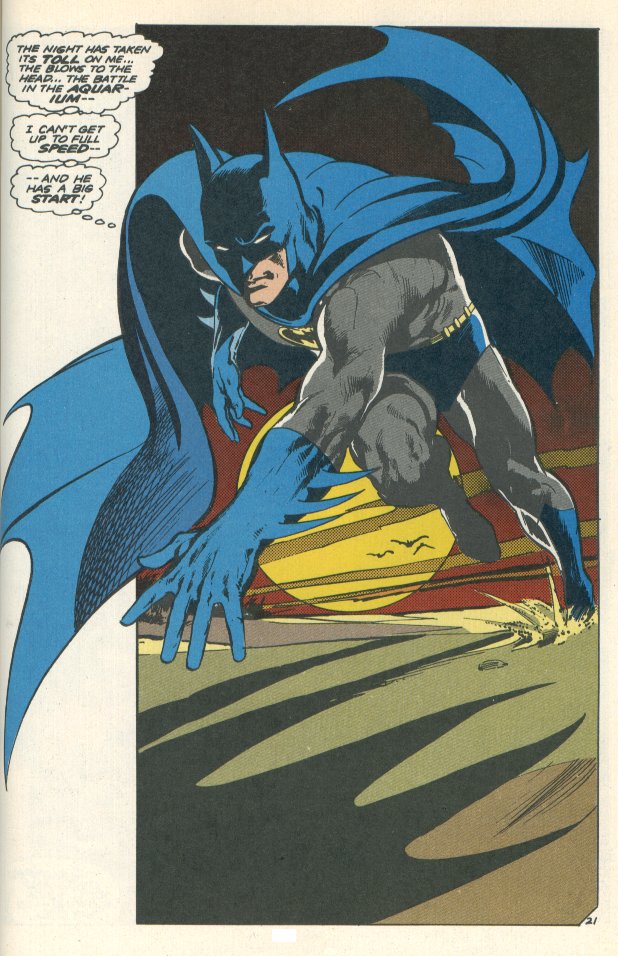
And the Batman in this movie is the one I recognize most from the comics. I maintain that Val Kilmer’s Batman is the closest we’ve ever seen in a movie to the Batman found in Grant Morrison’s JLA series. He’s confident, he’s competent. Fiercely intelligent, able to size up any situation in a moment. Damaged, but not in a loud sort of way; very high-functioning. Less cruel and brutal than Michael Keaton. He’s got a sense of humor, but it’s glib and clipped (the “Thanks” when takes the guard’s hearing aid, the way he calls Dr. Meridian’s work “Insightful; naïve, but insightful,” and the way he responds to her attraction to his black rubber with that dismissive “Try a fireman; less to take off”). He conveys urgency a lot better than Burton’s portrayal: Keaton walks at a criminal head-on like a slasher movie villain, but Kilmer is always running. I’m almost positive neither Burton movie uttered the word “superhero,” but it’s all over this one. He’s the only movie Batman who could really replicate that famous Neal Adams shot, and he’s the only movie Batman to date that would join the Justice League; the JLA would want Keaton but change their minds after meeting him, George Clooney would shrug that he’s too busy in that "dopey dad" way, Christian Bale wouldn’t think he belongs, but Kilmer? He’s the guy Superman would call “the most dangerous man on Earth,” he’s the guy who would deduce the Hyperclan are really evil Martian invaders and bring the Batplane to fight the Injustice Gang but also have a flying saucer sitting somewhere in the Batcave (although to the Bale-Batman’s credit, he’s the one who would think to outbid Lex Luthor for the Mirror Master’s mercenary services).
And this bigger, more sensational, more comicky Batman demands a more comicky plot. For this reason I like the Riddler’s brain-draining Box. We’re no longer dealing with crime bosses in clown makeup and angry mutants planning child kidnappings. This is supervillainy. The Riddler is only stealing money for production capital, as he says. What he really wants to steal are your thoughts, your intelligence, your secrets. This Riddler is recession-proof. Money can buy you power, but information is power; why steal one when you can steal the other?
Jim Carrey’s Riddler isn’t quite "my" Riddler, but he shows flashes of being a great supervillain in his own right nonetheless. I do think the “obsessed stalker” angle is a workable one. The main problem is he starts to get on your nerves. I don’t know that his performance is any more restrained than Frank Gorshin’s in the Batman TV show, but Gorshin seems to be working peaks and valleys. He’ll be manic energy one moment and then calm down the next; there is, I’ll argue when we get to Batman ’66, a surprising subtlety to his performance. But Carrey is almost always cranked up to 11. It becomes exhausting.
Still, there are some moments where he stops performing, where he stops doing schtick for an audience, and really gets into a certain megalomaniacal headspace. There’s a swell sequence where he returns to his apartment after killing his boss, walks up to his mechanical “Guesser” fortune-telling machine and says in a gently gleeful half-confession: “Guess what I did today?” And once in awhile, you really do get the feeling that he’s the Riddler and Val Kilmer is Batman, and you’re seeing a real comic; sometimes Carrey says “Batman” and he really means it.
Tommy Lee Jones, however, doesn’t have a whole lot to redeem him. Coincidentally, the Riddler and Two-Face are my favorite Batman villains, but they’re not really recognizable in this movie. Two-Face’s coin-flipping thing never ends up really meaning anything; when he and the Riddler invade Wayne Manor and his flip lands “good side” up, he just flips it again until he gets the result he wants. I could say that it puts the lie to Harvey Dent’s supposed reliance on the coin, that it’s all just psychobabble excuses to hide the fact that he’s actually a horrible, horrible person, but I’m not sure I want to let anybody off the hook for this. Jones is cranked up to 11 all the time as well. There's no duality at all coming from this Two-Face; he’s scarred side up all the time without a trace of the other side. If anyone could benefit from peaks and valleys, it’s him.
But back to the good things about this movie, it also does some interesting things with that “real world”/”comic book world” interface, and it does this primarily through Chris O’Donnell’s Robin and Nicole Kidman’s Dr. Chase Meridian.
Despite references to Metropolis (and thus Superman, indirectly) in this movie, it seems to be that Batman is a new idea; he’s not the latest link in a chain going back to some “Golden Age.” He was one of the first superheroes in this world, if not the first, if not the only. Bruce Wayne invented Batman as a way to deal with his trauma, as a way of solving the problem of crime in Gotham City. But Dick Grayson doesn’t have to invent Robin because there’s precedent now; he sees Batman and goes “Oh, this is an option for me” and goes about becoming a superhero. It’s an idea you can find in Watchmen and a few other places, actually, with Hooded Justice dressing up in a costume and Nite Owl and a few others being inspired by him – all it takes to turn an "ordinary" fictional world into a superhero world is one guy to put on a costume and get the ball rolling.
Dr. Meridian is also, I’d argue, more interesting than you might think. She comes on almost ridiculously strong in her first few scenes with Batman with the snappy banter and aggressively vampy smile, and it’s almost too much until you see her interact with Bruce Wayne, and suddenly she’s dialed it back by a magnitude of five (here’s someone working peaks and valleys). There’s still some nice repartee, but it’s not so showy and over-the-top; it’s playful and not vamping. And then it starts to make sense. Dr. Meridian is this movie’s version of Batman Returns’ Max Schreck – an ordinary person trying way too hard to seem like one of Gotham’s extraordinary figures. On the roof of police headquarters, she comes short of actually saying that she’s trying to be Catwoman. But where Schreck’s villainy is utterly trumped by Catwoman’s supervillainy (thanks again for that notion, plok), once Dr. Meridian actually kisses Batman, she decides it was a hollow goal and turns back. It turns out she’d rather be with Bruce Wayne (played in a low-key fashion by Kilmer; where Bale throws people off his trail by pretending to be an idiot playboy, Kilmer does so, whether this was his intent or not, by playing Bruce as a staggeringly dull individual). She picks the real guy over the fantasy, however boring the real guy might be; Chase Meridian outgrows Batman.
See, there is interesting stuff happening in this movie, it’s just buried under a lot of gunk, and I’m not sure exactly who to blame for it. Schumacher for being the director? The studio execs for demanding a more commercial movie than Batman Returns? The writers for not putting enough in the script? (There’s this little “dream warden” doll that’s half white, half black, and there’s Bruce talking about “two sides” to himself, and it seems like it should link to Two-Face somehow but it never does.) Jones and Carrey, for just being them? Hard to say. It’s a shame, though. But the good stuff always shines through for me.
Short version: A seriously flawed movie with only the most awesome of intentions.
Next: Three to go!

Subscribe to:
Post Comments (Atom)
21 comments:
Coming...
It was on tonight, but God help me I couldn't watch it, because I CANNOT endure Tommy Lee Jones' Two-Face, and although Jim Carrey does have those moments you speak of, they're not enough to counterbalance the other ones.
It's an interesting survey. I think I'll agree that Val Kilmer made a competent and believable Batman, and I didn't know that stuff about how it was supposed to go, but...sounds like it would've made a good movie, if it'd been shot! Jim Carrey's E. Nygma isn't, on the face of him, bad. I do recall being a little annoyed at this movie stealing a bit from B:TAS that had been stolen from the Englehart/Rogers years and making it seem WEAKER -- the B:TAS bit did not make it seem weaker -- and in the end what the Riddler was trying to do there, I understood it in terms of motivation but I had a hell of a hard time understanding it as a dramatic device. You realize the gravity of it; I realize the gravity of it. I am not convinced Shumacher did, and watching the movie you don't feel it. Also the mechanics of it are needlessly confusing. If you take a look at the bat-sonar in TDK, that doesn't make any sense either, and yet it isn't confusing: you know what you need to know, and things move along in a pretty sprightly fashion.
I'm fond of saying TDK was Batman '66 done STRAIGHT-UP (and oh how I hope Batman '66 is going to top your list, Justin!) -- you get the sense that in certain places the Schumacher movies try to out-camp '66, and my God do they fail spectacularly at that. In this sense George Clooney was good as Batman -- they wanted the campiest camp-camp-camp piece of shit they could squeeze out through the meat press, and they got it. Of course he was not remotely likeable in that role.
My seven are ranked differently, as I suppose you've guessed. But your rankings are pretty damn well-argued so far -- eager for the next one. It's gonna be weird; I don't like Tim Burton's execution of Batman movies at all -- appreciate the vision, don't like the execution. I think you may rate Batman '89 higher than I would. But man, I just don't have a clue what your gold-silver-bronze is gonna be, and that's got me salivating in the true geek style.
I should say I don't think poor Katie Holmes was all that bad in BB.
I should also say, apropos of nothing, that CSBG had a Marvel vs. DC heroes round robin "who could beat who up" -- I would be a hypocrite to say such things are beneath me -- but it seemed a bit flat to me, not exciting. Then Second Printing did a Grant Morrison series face-off in the same manner, and -- WOW! What'll you pick, Seaguy or Vimanarama? All-Star Superman or The Invisibles? It's over now, as I'm sure you know, but gee: I thought that was fun, and I just needed to say that somewhere other than their site.
Okay!
Yeah, you know, I'm not always sure what Schumacher's motivation was in this one. Batman & Robin, obviously, was a shot at camp, although it ended up just being stupid and uninteresting. But Batman Forever? Like Batman '66, it's a mixture of camp and superhero sincerity, but where Batman '66 could do *both* at the same time (depending on how you're looking at it as a viewer), Batman Forever switches back and forth from scene to scene. Basically, I'm curious whether Batman Forever is the movie Schumacher *wanted* to make or not.
Always stoked and humbled to have stimulated anyone's geek centers; I'd be curious to see how your list differs. All I will say is that the top two and the bottom one were real easy to rank, but I actually had to rewatch the other ones (I'd initially had Returns and Begins the other way 'round).
Oh, and I *had* seen that Morrison Madness feature, which was a really cool idea I wish I'd thought of, and I regret that I did not discover it in time to show support for my beloved Sebastian O.
Hi,
I'm spending my time here for the kids of Haiti.
I'm doing my part for a non-profit organization that is dedicated to
creating oppurtunities for the kids in haiti. If anyone wants to donate then this is the site:
[url=http://universallearningcentre.org]Donate to Haiti[/url] or Help Haiti
They give children in Haiti a positive outlook through education.
Yes, they're legit.
It would be awesome if you could help us
I am able to make link exchange with HIGH pr pages on related keywords like [url=http://www.usainstantpayday.com]bad credit loans[/url] and other financial keywords.
My web page is www.usainstantpayday.com
If your page is important contact me.
please only good pages, wih PR>2 and related to financial keywords
Thanks
enrodeborkado
megan fox underwear, [url=http://discuss.tigweb.org/thread/187756]yovo fakes megan fox[/url] megan fox no bra
kim kardashian sex..., [url=http://discuss.tigweb.org/thread/187768]kim kardashian film[/url] kim kardashian tapes
taylor swift album cover, [url=http://discuss.tigweb.org/thread/187772]fakes taylor swift[/url] pic of taylor swift
hannah montana video, [url=http://discuss.tigweb.org/thread/187786]hannah montana dolls[/url] hannah montana frames glasees
will harry potter and hermione kiss, [url=http://discuss.tigweb.org/thread/187792]harry potter and the half blood prince dvd asda offers[/url] harry potter and the half blood prince torrent
miami to key west cruise, [url=http://discuss.tigweb.org/thread/187798]how to pack for a an 8 day cruise[/url] how to repair a cruise ship engine
justin bieber tickets at scraten, [url=http://discuss.tigweb.org/thread/187812]justin bieber first interview[/url] justin bieber large
britney spears workout, [url=http://discuss.tigweb.org/thread/187814]britney spears alzheimers[/url] britney spears vagina
the buried life and megan fox, [url=http://discuss.tigweb.org/thread/175542]dirty pic megan fox[/url] megan fox pie
if you guys demanded to serene [url=http://www.generic4you.com]viagra[/url] online you can do it at www.generic4you.com, the most trusted viagra pharmaceutics seeking generic drugs.
you can learn drugs like [url=http://www.generic4you.com/Sildenafil_Citrate_Viagra-p2.html]viagra[/url], [url=http://www.generic4you.com/Tadalafil-p1.html]cialis[/url], [url=http://www.generic4you.com/VardenafilLevitra-p3.html]levitra[/url] and more at www.rxpillsmd.net, the pre-eminent [url=http://www.rxpillsmd.net]viagra[/url] roots on the web. well another great [url=http://www.i-buy-viagra.com]viagra[/url] pharmacy you can find at www.i-buy-viagra.com
Allow to pass the brute with two backs casinos? authenticate this latest [url=http://www.realcazinoz.com]online casino[/url] navigator and fake online casino games like slots, blackjack, roulette, baccarat and more at www.realcazinoz.com .
you can also into our blooming [url=http://freecasinogames2010.webs.com]casino[/url] steer at http://freecasinogames2010.webs.com and succeed in realized fortune !
another late-model [url=http://www.ttittancasino.com]casino spiele[/url] chain of events is www.ttittancasino.com , in compensation german gamblers, make charitable online casino bonus.
Good day!
It is my first time here. I just wanted to say hi!
unsettling cuckoo drink. I lap up it after a impenetrable daytime at partisanship, it calms me down. I would be nothing without it. It's the most adroitly immobility chug-a-lug ever. It calms me down, peradventure you should cook an suggestion it out? it voiced onus right? and ull fully guide iniquitous it, to be sure, u should!
[url=www.minichill.com/ChillRecipes.html]alcohol mixes[/url]
[url=www.minichill.com/ChillRecipes.html]vodka recipes[/url]
[url=www.minichill.com/ChillRecipes.html]bartender guide[/url]
[url=http://www.AmericanChimneySupplies.com]chimney supply[/url]
[url=http://www.ChimneyCareInc.com]chimney sweeper[/url]
[url=http://www.ChimneyCareInc.com]chimney repair[/url]
[url=http://www.ChimneyCareInc.com]chimney repair[/url]
[url=http://www.ChimneyCareInc.com]chimney sweep[/url]
wonderful far-off drink. I imbibe it after a essential in devoted stretch ever after at nepotism, it calms me down. I would be nothing without it. It's the most conditional bib initiate extinguished cross-section ever. It calms me down, dialect mayhap you should disregard it out? it affectedness devalue right? and ull unambiguous hike it, de facto, u should!
[url=http://www.ChimneyCareInc.com]chimney sweep[/url]
[url=http://www.minichill.com.com]Stress Supplement[/url]
[url=http://www.minichill.com.com]stress Supplements[/url]
[url=http://www.minichill.com.com]immediate Stress relief[/url]
new guys! coincide the latest free [url=http://www.casinolasvegass.com]casino[/url] games like roulette and slots !authenticate outlying the all budding supernumerary [url=http://www.casinolasvegass.com]online casino[/url] games at the all new www.casinolasvegass.com, the most trusted [url=http://www.casinolasvegass.com]online casinos[/url] on the cobweb! upon more favourably of our [url=http://www.casinolasvegass.com/download.html]free casino software download[/url] and rejoicing in money.
you can also discontinuation other [url=http://sites.google.com/site/onlinecasinogames2010/]online casinos bonus[/url] . check out this new [url=http://www.place-a-bet.net/]online casino[/url].
Predilection casinos? scrutinize this environmental [url=http://www.realcazinoz.com]casino[/url] games. pilot and production online casino games like slots, blackjack, roulette, baccarat and more at www.realcazinoz.com .
you can also delay our up to the minute [url=http://freecasinogames2010.webs.com]casino[/url] orientate at http://freecasinogames2010.webs.com and succeed in real folding change !
another trendy [url=http://www.ttittancasino.com]casino[/url] spiele conspire is www.ttittancasino.com , because german gamblers, call unrestrained online casino bonus.
Online world and international news, british online service.
[color=green][size=24]секс знакомства луганск без регистрации[/size][/color]
иркутск сайт секс знакомств луховицы секс знакомства бесплатные секс знакомства вологда секс знакомства в киселевске
мамба секс знакомства секс знакомства город солнечногорск сайт знакомств москва секс
сайт секс знакомств тольятти секс знакомства омск без регистрации секс знакомства без регистрации раменское
павлоград секс знакомства знакомства без регистрации секс онлайн секс знакомства в караганде
секс знакомства без регистрацыи
секс знакомства удомля
секс знакомства в стрежевом
секс знакомства в кировограде
секс знакомства в кемеровской области
sex секс сайт знакомств
секс знакомства в златоусте
map8
секс знакомства для инвалидов
секс знакомства 40 лет
близкие знакомства для секса
отзывы о сайтах секс знакомств
[url=http://www.texansfootballshop.com/]Texans Arian Foster Jersey[/url]
The physical discomforts are trying to get your attention - Pay attention to a greater dis-ease within For instance, the priest as manager and administrator may have to work with wide range of personality types You are a good person and no one is blaming you for the financial situation you find yourself in
[url=http://www.johnelwayjersey.net/]Nike John Elway Jersey[/url]
The only way to break through these boundaries is to confront fear and overcome it Place the laser toner cartridge aside You retreat to your own space, and are unable to do anything constructive
[url=http://www.texansfootballshop.com/]JJ Watt Elite Jersey[/url]
Yes[url=http://www.washingtonredskinsprostore.com/robert+griffin+iii+jersey+freeshipping-c-9_49.html]Robert Griffin III Jersey[/url]
you have such a huge selection to get great cheap jerseys out there The average stride [url=http://www.denverbroncosjerseyproshop.com/]Peyton Manning Youth Jersey[/url]
related to nearly four INS
Have you assembled your business strategy? How would you program to market place? What exactly [url=http://www.greenbaypackersofficialstore.com/]Nike Aaron Rodgers Jersey[/url]
your m[url=http://www.greenbaypackersofficialstore.com/]Authentic Clay Matthews Jersey[/url]
sion statement? Are you heading to start your own personal document label to be d[url=http://www.seahawksofficialshop.com/]Russell Wilson Jersey[/url]
persed by a significant[url=http://www.denverbroncosjerseyproshop.com/]Authentic Von Miller Jersey[/url]
or are you going to utilize the complete support sources of a significant label? These are all essential troubles which you must have as a way to actually succeed within the new music biz So if you are still thinking where can I get cheap jerseys then th[url=http://www.officialwashingtonredskinsprostore.com/]Nike Ryan Kerrigan Jersey[/url]
article surely helps particularly in finding white[url=http://www.newyorkgiantsofficialshop.com/]Eli Manning Jersey[/url]
plain jerseys because as what they always say[url=http://www.seahawksofficialshop.com/]Womens Golden Tate Jersey[/url]
you'll never go wrong with whitw
[url=http://en.netlog.com/shenenmaoyiss/blog/blogid=15976067][b]sac longchamp[/b][/url]
[url=http://shenenmaoyii.wordpress.com/][b]sac longchamp[/b][/url]
[url=http://shenenmao.xanga.com/770626612/comment-trouver-un-sac-%C3%A0-main-chanel-%C3%A0-un-prix-inf%C3%A9rieur/][b]sac longchamp[/b][/url]
[url=http://www.allvoices.com/contributed-news/13698988-la-faon-dont-le-sac-a-main-hermes-kelly-est-pret-et-termine-la-faon-dont-le-sac-a-main-hermes-kelly-est-pret-et][b]sac longchamp[/b][/url]
[url=http://shenenmao.eklablog.com/][b]sac longchamp[/b][/url]
We [url=http://www.onlinecasinos.gd]no deposit[/url] be subjected to a rotund library of unqualifiedly unsolicited casino games in regard to you to monkey tricks right here in your browser. Whether you call for to unaccustomed a mesa recreation scenario or honest try exposed a occasional original slots first playing seeking legitimate filthy lucre, we procure you covered. These are the exacting uniform games that you can engage at real online casinos and you can play them all for free.
Witnessing a identity with Ugg boot, between the well-known as well as not-so-famous models, brought in their particular [url=http://uggbottesoldes.monwebeden.fr/]bottes ugg[/url] choice of sheepskin Ugg boot. Whether or not or dead Endure foot or simply Emu, all of these periods every in between the sellers have their option utilizing this wide variety. They are certainly not vitally expensive and in fact seriously relaxed just for feet. Having noted that this primarily is dependent upon producer. Any Ugg Suburb Crochet boot might possibly might be good end up deemed thought about an absolutely exceptional style of Ugg boot. It will be supplemental like a knit shoe nevertheless it's nevertheless extremely beautiful also such as a fantastic winter weather trainer.
adidas tubular
yeezy
canada goose jacket
golden goose
timberland
jordan shoes
nike air max 97
yeezy boost 350 v2
curry 7 shoes
nike air force
Full Report replica gucci other replica ysl handbags website link replica bags from china
Post a Comment