
I still haven't finished those posts that I've been meaning to do, but I did feel compelled to dash off a short (for me, anyway) comparison between the Joker as seen in Batman: The Animated Series and the Joker as portrayed in contemporary comics and other media.
To keep this from being a totally uncritical love-in about a fan-favorite show: One of my favorite portrayals of the Joker, the Riddler and a bunch of other characters, but Two-Face-as-multiple-personality is not my cup of tea, even though the episodes were really good.
Showing posts with label movies. Show all posts
Showing posts with label movies. Show all posts
Monday, May 31, 2010

Monday, May 10, 2010
Iron Man 2, plus What Has Been Going On With Me
Hey dudes. How have you been?
I saw Iron Man 2 opening day, and of course I will tell you what I think, and I will be brief, and I will not divulge any spoilers, because I do not want to mess about with inviso-text.
The movie is a very good time. Not, perhaps, as good as the first movie, in part because instead of a left-field success this is now a planned summer tentpole superhero blockbuster, and so more time is spent on superhero movie business (more villains, evil plot, etc.). The filmmakers, like in the first movie, are still more interested in the Tony Stark side of things than the Iron Man side of things. This is good, because for the purposes of this movie I am also more interested in Tony Stark and the implications of the Iron Man technology than actual superhero stuff, but the demands of an action movie require action sequences, and while there's not too many of them, they can feel a bit perfunctory (like the last movie, the big climactic battle is the least interesting part of the whole thing, as though every one involved would have rather been doing something else with the end of the movie).
What else...Robert Downey Jr. is winning as always. Sam Rockwell is awesome as an ambitious-but-hapless businessman who doesn't just want to usurp Stark's technology, but also his flair and public persona. Mickey Rourke is sufficiently menacing. Samuel L. Jackson has obliged to not chew as much scenery as he is capable of doing.
A disappointment: The movie brings up a potentially interesting moral/ethical dilemma - you are inclined to side with Stark that the military can't be trusted with his designs, and yet a guy who's cool with using his deadly repulsor ray technology whilst drunk to entertain party guests in not really the guy you want with that kind of firepower either. But the movie doesn't really engage with it beyond "Yep, our hero was right all along." I know not every superhero movie's built to be as ambiguous as The Dark Knight, but this one kind of set me up for something it didn't deliver.
Also: I do not for one second believe that this Avengers movie is ever going to actually happen. NOT IN ONE MILLION YEARS.
Anyway. Very very good show. Better than X-Men 2, not as good as Iron Man.
I went to see it with my brother, and not my wife (who really enjoyed the first one) because she's on bed rest until she has the baby. The due date was supposed to be May 30 or so, but now they're hoping she'll make it another week or two. No cause for immediate alarm - her blood pressure's just a bit high, and it goes down when she's laying down on her side. So she's stuck home from work reading (All-Star Superman got the thumbs up) and watching TV, which is, of course, my personal idea of heaven, but it is not a belief in the afterlife she shares.
And, as a result of getting the apartment all set up for the baby (and we are, now) and Alison basically out of commission, I have been quite busy, and not posting as much as I would like.
And I would like! I've got an ode to Bronze Age Spider-Man I'm tinkering with (I think I can say there's more than nostalgia at work here, because I was not alive for much of the Bronze Age) for here, and a piece about "following" superhero comics - in the same way one can "follow" Major League Baseball or whatever by reading the paper and watching SportsCenter without ever having to actually watch a single game - for MGK's. This is going to be dependent on when my status flips from "I do not have a baby in my home" to "My home contains one (1) baby," and it's hard to say exactly when that will be. So: Not now, but ... soon?
I will keep you informed.
EDIT/UPDATE: Baby ETA - Wednesday, May 19. Plans are in the works to induce labor that Tuesday. So you have until then to buy cigars. Get on it.
I saw Iron Man 2 opening day, and of course I will tell you what I think, and I will be brief, and I will not divulge any spoilers, because I do not want to mess about with inviso-text.
The movie is a very good time. Not, perhaps, as good as the first movie, in part because instead of a left-field success this is now a planned summer tentpole superhero blockbuster, and so more time is spent on superhero movie business (more villains, evil plot, etc.). The filmmakers, like in the first movie, are still more interested in the Tony Stark side of things than the Iron Man side of things. This is good, because for the purposes of this movie I am also more interested in Tony Stark and the implications of the Iron Man technology than actual superhero stuff, but the demands of an action movie require action sequences, and while there's not too many of them, they can feel a bit perfunctory (like the last movie, the big climactic battle is the least interesting part of the whole thing, as though every one involved would have rather been doing something else with the end of the movie).
What else...Robert Downey Jr. is winning as always. Sam Rockwell is awesome as an ambitious-but-hapless businessman who doesn't just want to usurp Stark's technology, but also his flair and public persona. Mickey Rourke is sufficiently menacing. Samuel L. Jackson has obliged to not chew as much scenery as he is capable of doing.
A disappointment: The movie brings up a potentially interesting moral/ethical dilemma - you are inclined to side with Stark that the military can't be trusted with his designs, and yet a guy who's cool with using his deadly repulsor ray technology whilst drunk to entertain party guests in not really the guy you want with that kind of firepower either. But the movie doesn't really engage with it beyond "Yep, our hero was right all along." I know not every superhero movie's built to be as ambiguous as The Dark Knight, but this one kind of set me up for something it didn't deliver.
Also: I do not for one second believe that this Avengers movie is ever going to actually happen. NOT IN ONE MILLION YEARS.
Anyway. Very very good show. Better than X-Men 2, not as good as Iron Man.
I went to see it with my brother, and not my wife (who really enjoyed the first one) because she's on bed rest until she has the baby. The due date was supposed to be May 30 or so, but now they're hoping she'll make it another week or two. No cause for immediate alarm - her blood pressure's just a bit high, and it goes down when she's laying down on her side. So she's stuck home from work reading (All-Star Superman got the thumbs up) and watching TV, which is, of course, my personal idea of heaven, but it is not a belief in the afterlife she shares.
And, as a result of getting the apartment all set up for the baby (and we are, now) and Alison basically out of commission, I have been quite busy, and not posting as much as I would like.
And I would like! I've got an ode to Bronze Age Spider-Man I'm tinkering with (I think I can say there's more than nostalgia at work here, because I was not alive for much of the Bronze Age) for here, and a piece about "following" superhero comics - in the same way one can "follow" Major League Baseball or whatever by reading the paper and watching SportsCenter without ever having to actually watch a single game - for MGK's. This is going to be dependent on when my status flips from "I do not have a baby in my home" to "My home contains one (1) baby," and it's hard to say exactly when that will be. So: Not now, but ... soon?
I will keep you informed.
EDIT/UPDATE: Baby ETA - Wednesday, May 19. Plans are in the works to induce labor that Tuesday. So you have until then to buy cigars. Get on it.
Sunday, April 18, 2010
What I Have Been Doing In My Spare Time
1.) Coming up with a second entry for Pillock's "Write a proposal for a TV show set in space" thing (Plok, man, when are we all supposed to be posting these things?)
2.) Trying to decide which organs I can sell to help ease any financial strain that having a baby in about six weeks will create. (To be blunt, Left Kidney ... what have you done for me lately?)
3.) Aggressively not going to see Kick-Ass, because please, media people, do not make a big deal about whether or not this movie goes too far in its portrayal of violence! You are only giving Mark Millar what he wants! Do not feed the bear!
4.) Talkin' Mission: Impossible down at the ol' Mightygodking.com.
2.) Trying to decide which organs I can sell to help ease any financial strain that having a baby in about six weeks will create. (To be blunt, Left Kidney ... what have you done for me lately?)
3.) Aggressively not going to see Kick-Ass, because please, media people, do not make a big deal about whether or not this movie goes too far in its portrayal of violence! You are only giving Mark Millar what he wants! Do not feed the bear!
4.) Talkin' Mission: Impossible down at the ol' Mightygodking.com.
Saturday, April 17, 2010
Thought for Today: The Chicago Way
Whenever I watch Brian DePalma's The Untouchables, I really enjoy it, but I'm never quite sure whether what I'm watching is actually a good movie or a bad movie. Even the things I suspect are or identify as "bad" ("He's in the car.") I rationalize in my head as intentional choices to provoke a desired effect that enhances the film.
Well, except for Sean Connery's Irish accent.
Well, except for Sean Connery's Irish accent.
Saturday, March 13, 2010
Such strange things did I viddy in my dream, O my brothers…
All right, you guys, I had the weirdest dream. So weird, in fact, that I felt I had to tell it in detail here.
This dream was long, uninterrupted, very vivid, and extremely geeky in all respects, which is extremely odd because my dreams are usually none of those four things. I had not had a particularly geeky day; I had read no comics, watched no movies or TV, not even thought much about anything to that effect – I fell asleep on the couch at one point reading A Clockwork Orange, but that did not factor into my dream in any way (thank goodness for small favors, one supposes). I also want to stress that I am getting over a cold, but I had not taken any NyQuil or anything like that which might be blamed for the dream. I had one bottle of hard cider, essentially equivalent to a single bottle of beer, at around 10 p.m., and anyway the dream must have started after 6 a.m. sometime, so I do not think that ought to have played a factor.
I was, however, extremely tired that night.
I am going to provide links in the anchor text for people who might not get every single reference (hello, Zach … and possibly my dad). I just had to share it because I do not remember ever having such a concentrated pop-culture dream.
* * *
The earliest part I can remember begins with Batman protecting a mobster in the basement of police headquarters in Gotham City. The headquarters was basically the one from The Dark Knight, but Batman was a very ‘90s looking comic book Batman (not actually Kelley Jones, but someone who would have drawn part of Knightfall or something), and the mobster was Al Pacino, but Al Pacino as Big Boy from Dick Tracy.
Now, in my dreams I tend to, like, “transfer consciousness” a lot, where I’ll be “playing” one role in the dream, and then halfway through I’ll transfer to another “character” in the dream. So in this one, I think I started out as Pacino, because I remember being worried that the Scarecrow was coming to kill me (hence being under police and Bat protection), but at some point I must have switched to Batman, because Pacino excuses himself for the bathroom and didn’t come back. As Batman, I investigate the bathroom and find there was a large, loose panel that must slide back and lead to some hidden tunnel. But I’m terrified to look in it. Like, horribly, deathly terrified that if I slidd it open, some horrible thing would come out and kill me.
So I get Agent Scully to do it. The deal was, she’d point her gun at the panel as I (suddenly Mulder) open up the panel. There was somebody cowering in the bathtub as well. Maybe it was Pacino/Big Boy, although he was supposed to be gone. So I open it up, and Scully assures me there was nothing moving inside. It looks, in fact, just like some weird cave that leads into the darkness. Scully goes in, and I follow her.
And suddenly I am no longer Mulder in the tunnel, but I am me reading a comic book of these events at a picnic table in the park on a sunny day. The comic book is an issue of Fantastic Four, and the FF are going through the tunnel, and it winds up in some sort of buried underground New York filled with the sort of denizens you would expect to inhabit a comic book underground New York. I finish the comic, and I am convinced that this is the greatest issue of Fantastic Four I’ve read in years and years, and I look back at the credits and see that it is apparently a contemporary issue of Fantastic Four drawn by Steve Ditko.
So I’m going on and on about how great this issue of Fantastic Four was to the guy sitting at the picnic table with me, and that guy is Kurt Busiek, who asks me if I’d like to tell Ditko that myself (Busiek, for whatever reason, has Ditko’s phone number). So I say I would, and I call Ditko on my cell phone and discover, contrary to his reputation for being a recluse who never talks to fans, very friendly and open. I keep gushing, just wretched fannish gushing, about how great I thought this comic was, and Ditko tells me where he got the idea for the underground city, the backstory he’d created for it, all of it.
And then suddenly, I see Ditko’s lips moving, and they’re surrounded by a fluffy white beard. The camera pulls back (I am no longer in the park on the phone, but rather watching TV) to reveal it’s John Travolta, except that he looks like he’s been cast in the lead of the new Santa Clause movie, and he’s “playing Ditko.” (It should be noted that Steve Ditko in no way looks like that, of course.) He hangs up the phone and says, “Live from New York, it’s Saturday Night!”
So I guess I’m watching Saturday Night Live, right? And Travolta in his Santa beard is hosting. And we go right into the first sketch, which, in defiance of all reason, is another sketch in which Travolta is playing Ditko.
The conceit of the sketch is that Steve Ditko and Stan Lee are corresponding to each other, except it is Victorian London, and Ditko is basically Bob Cratchit, and Lee is basically Ebenezer Scrooge. And Travolta-as Ditko-as Cratchit is wearing some kind of footie pajamas and standing on the cobblestone, and I’m aware of how hard and sharp and hot the ground is on his feet because suddenly I am Travolta-as Ditko-as Cratchit, and I start walking toward where I know Lee/Scrooge’s office to be, and every step is painful.
And then, all of a sudden, I am me again, and I am in the Mall of America with my father and brother (the three of us are actually going to Minneapolis for something this month, so this is not altogether weird yet). We’re walking by a bunch of movie company boutiques – there’s a Disney store and a Warner Bros. store. And then, strange though it may seem, there is a store devoted entirely to Ghostbusters memorabilia, as indicated by a sign that’s nothing but the logo.
So I pull my father and brother into the store and I am just ecstatic (as one would be if one discovered against all odds that a Ghostbusters store would be profitable enough to stay in business). Stranger still, inside the store, the ceilings are very high – we’re talking three stories, maybe, and the ceilings were molded white plaster (apparently we were supposed to be in the Ghostbusters firehouse, although I do not recall the Ghostbusters firehouse looking anything like that).
Now, not only is there Ghostbusters memorabilia in this store, there is also some kind of weird nightclub at the back of the store, and all the employees are wearing like Ghostbusters uniforms. My dad asks my brother and me if we want anything to drink, and I consider a rum and coke, but it seems weird to have a rum and coke at a nightclub in a Ghostbusters store at the mall, so I just order a Diet Hi-C (I am not sure that such a product exists). It comes in a paper cup like at a fast food restaurant, and I grab a lid, and just like I always do in real life, the first lid I grab is a size too small and so I have to take a bigger one too, and now I can’t put that small lid back because I’ve already touched it and I feel bad for being wasteful.
So I’m drinking my Diet Hi-C and we’re leaving the store, and the three of us talk about where we’d like to get dinner in the mall. My dad suggests Burger Hole, and my brother is not having any of that. He’s like, “Burger Hole? That place is a hole!” And I’m trying to remember where I know the name “Burger Hole” from, and I think, Isn’t that the name of the restaurant in the movie Role Models?
And then I wake up.
* * *
So that’s the dream. I shudder to think that any of it means anything. My wife and I bought a crib and changing table that night, so I’d hate to think this is some sort of weird metaphor for impending fatherhood in some way.
That is all.
This dream was long, uninterrupted, very vivid, and extremely geeky in all respects, which is extremely odd because my dreams are usually none of those four things. I had not had a particularly geeky day; I had read no comics, watched no movies or TV, not even thought much about anything to that effect – I fell asleep on the couch at one point reading A Clockwork Orange, but that did not factor into my dream in any way (thank goodness for small favors, one supposes). I also want to stress that I am getting over a cold, but I had not taken any NyQuil or anything like that which might be blamed for the dream. I had one bottle of hard cider, essentially equivalent to a single bottle of beer, at around 10 p.m., and anyway the dream must have started after 6 a.m. sometime, so I do not think that ought to have played a factor.
I was, however, extremely tired that night.
I am going to provide links in the anchor text for people who might not get every single reference (hello, Zach … and possibly my dad). I just had to share it because I do not remember ever having such a concentrated pop-culture dream.
I swear, what you are about to read is not exaggerated from my recollection in any way.
* * *
The earliest part I can remember begins with Batman protecting a mobster in the basement of police headquarters in Gotham City. The headquarters was basically the one from The Dark Knight, but Batman was a very ‘90s looking comic book Batman (not actually Kelley Jones, but someone who would have drawn part of Knightfall or something), and the mobster was Al Pacino, but Al Pacino as Big Boy from Dick Tracy.


Now, in my dreams I tend to, like, “transfer consciousness” a lot, where I’ll be “playing” one role in the dream, and then halfway through I’ll transfer to another “character” in the dream. So in this one, I think I started out as Pacino, because I remember being worried that the Scarecrow was coming to kill me (hence being under police and Bat protection), but at some point I must have switched to Batman, because Pacino excuses himself for the bathroom and didn’t come back. As Batman, I investigate the bathroom and find there was a large, loose panel that must slide back and lead to some hidden tunnel. But I’m terrified to look in it. Like, horribly, deathly terrified that if I slidd it open, some horrible thing would come out and kill me.

So I get Agent Scully to do it. The deal was, she’d point her gun at the panel as I (suddenly Mulder) open up the panel. There was somebody cowering in the bathtub as well. Maybe it was Pacino/Big Boy, although he was supposed to be gone. So I open it up, and Scully assures me there was nothing moving inside. It looks, in fact, just like some weird cave that leads into the darkness. Scully goes in, and I follow her.
And suddenly I am no longer Mulder in the tunnel, but I am me reading a comic book of these events at a picnic table in the park on a sunny day. The comic book is an issue of Fantastic Four, and the FF are going through the tunnel, and it winds up in some sort of buried underground New York filled with the sort of denizens you would expect to inhabit a comic book underground New York. I finish the comic, and I am convinced that this is the greatest issue of Fantastic Four I’ve read in years and years, and I look back at the credits and see that it is apparently a contemporary issue of Fantastic Four drawn by Steve Ditko.
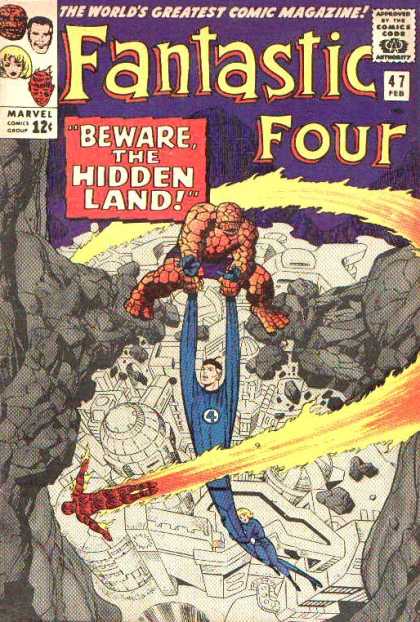
So I’m going on and on about how great this issue of Fantastic Four was to the guy sitting at the picnic table with me, and that guy is Kurt Busiek, who asks me if I’d like to tell Ditko that myself (Busiek, for whatever reason, has Ditko’s phone number). So I say I would, and I call Ditko on my cell phone and discover, contrary to his reputation for being a recluse who never talks to fans, very friendly and open. I keep gushing, just wretched fannish gushing, about how great I thought this comic was, and Ditko tells me where he got the idea for the underground city, the backstory he’d created for it, all of it.
And then suddenly, I see Ditko’s lips moving, and they’re surrounded by a fluffy white beard. The camera pulls back (I am no longer in the park on the phone, but rather watching TV) to reveal it’s John Travolta, except that he looks like he’s been cast in the lead of the new Santa Clause movie, and he’s “playing Ditko.” (It should be noted that Steve Ditko in no way looks like that, of course.) He hangs up the phone and says, “Live from New York, it’s Saturday Night!”

So I guess I’m watching Saturday Night Live, right? And Travolta in his Santa beard is hosting. And we go right into the first sketch, which, in defiance of all reason, is another sketch in which Travolta is playing Ditko.
The conceit of the sketch is that Steve Ditko and Stan Lee are corresponding to each other, except it is Victorian London, and Ditko is basically Bob Cratchit, and Lee is basically Ebenezer Scrooge. And Travolta-as Ditko-as Cratchit is wearing some kind of footie pajamas and standing on the cobblestone, and I’m aware of how hard and sharp and hot the ground is on his feet because suddenly I am Travolta-as Ditko-as Cratchit, and I start walking toward where I know Lee/Scrooge’s office to be, and every step is painful.
And then, all of a sudden, I am me again, and I am in the Mall of America with my father and brother (the three of us are actually going to Minneapolis for something this month, so this is not altogether weird yet). We’re walking by a bunch of movie company boutiques – there’s a Disney store and a Warner Bros. store. And then, strange though it may seem, there is a store devoted entirely to Ghostbusters memorabilia, as indicated by a sign that’s nothing but the logo.
So I pull my father and brother into the store and I am just ecstatic (as one would be if one discovered against all odds that a Ghostbusters store would be profitable enough to stay in business). Stranger still, inside the store, the ceilings are very high – we’re talking three stories, maybe, and the ceilings were molded white plaster (apparently we were supposed to be in the Ghostbusters firehouse, although I do not recall the Ghostbusters firehouse looking anything like that).
Now, not only is there Ghostbusters memorabilia in this store, there is also some kind of weird nightclub at the back of the store, and all the employees are wearing like Ghostbusters uniforms. My dad asks my brother and me if we want anything to drink, and I consider a rum and coke, but it seems weird to have a rum and coke at a nightclub in a Ghostbusters store at the mall, so I just order a Diet Hi-C (I am not sure that such a product exists). It comes in a paper cup like at a fast food restaurant, and I grab a lid, and just like I always do in real life, the first lid I grab is a size too small and so I have to take a bigger one too, and now I can’t put that small lid back because I’ve already touched it and I feel bad for being wasteful.

So I’m drinking my Diet Hi-C and we’re leaving the store, and the three of us talk about where we’d like to get dinner in the mall. My dad suggests Burger Hole, and my brother is not having any of that. He’s like, “Burger Hole? That place is a hole!” And I’m trying to remember where I know the name “Burger Hole” from, and I think, Isn’t that the name of the restaurant in the movie Role Models?
And then I wake up.
So that’s the dream. I shudder to think that any of it means anything. My wife and I bought a crib and changing table that night, so I’d hate to think this is some sort of weird metaphor for impending fatherhood in some way.
That is all.
Sunday, January 17, 2010
"And Nothing To Do But Go On Home" (or: "Dudes, Remember Bryan Singer Made A Superman Movie?")
Holy crap, Superman Returns, aren't you an hour and forty-five minutes drowning in a two-and-a-half-hour movie? (And, on AMC, it's a three-and-a-half-hour affair, but I hadn't seen it since it was out in theaters and decided to give it another go.)
I'm not even saying there should have been more action (couldn't've hurt, though), and I'm certainly not going to insist "Superman needs to punch somebody" because he most certainly does not have to ... but man, this is a movie in need of some content. Maybe you could get away with long, silent glances if they seemed to signify something, either in the writing or in the acting, but it's an awful lot of audience participation going on there - "Fill in the blanks, kids, what do you think Lois is feeling but can't find the words to express?"
But what makes that two-and-a-half hours inexcusable is that the movie doesn't have any payoff, not really, anyway. I mean, the whole secret-child angle and competing with the kid's swell-guy dad for Lois' affections - it's not my favorite idea, I'll admit. But it could be interesting. Spare me the "faithful adaptation"; at this point, I'd much rather watch a movie like The Dark Knight, that takes a risk by using these concepts as a springboard to talk about things that matter to somebody, than an updated Superman origin using CGI. So I am totally willing to give this a shot. And it does start out very amibitiously, even to the point where I'm thinking on this second viewing, Man, maybe they really are going somewhere with this.
But they don't. Lot of questions to be sure, and that gives it the illusion of gravity: How does Superman cope with a world that's moved on in his absence? What would fatherhood mean for the Man of Steel? (Hey, that one might be something I could get into now.) Most importantly, as Eliott S! Maggin put it, "Must There Be A Superman?"
But at the end of the movie, I don't know. The movie doesn't answer any of those questions. Okay, Dark Knight doesn't give you the firm answer on any of the questions it poses, either, but it engages with them so that you can work it out yourself. You can debate the morality of the characters' actions in The Dark Knight - even that crap about "Batman is George W Bush" ... there's at least enough material in the movie where there's a case to be made.
But Superman Returns doesn't give you even that much. It lays before you a bunch of questions and then refuses to give you the tools to answer them with. This is a movie that's really just shrugging its shoulders, saying "Hey, don't ask me, I'm just puttin' it out there. I mean, I'm just sayin' is all..."
So what's the point of Superman Returns, ultimately? If it's spectacle, it's dragging in places. If it's a love story, the leads don't connect. It hits the Superman-as-Christ-figure beats, but only in that totally superficial screenwritery way. That bit at the end with Superman giving his son the same speech his father gave him - surely that's too thin, too irrelevant to you and I to justify 150 rather ponderous minutes.
And then Superman flies away into the sky, and they play that John Williams theme, and Brandon Routh does that same fly-by-the-camera thing Christopher Reeve used to do ... well, what does that mean? Because that music's always meant "Superman's saved the day and everything is fine" in the previous movies this film is so dutifully referencing. But there is no closure in this movie, so that music's just hollow. Rather cynically, it's using that familiar score to fool you into thinking that the movie is over - "Yep, that's it, everything's resolved ... you wouldn't be hearing that music if it wasn't, right?"
What is the point? You've got the Christ stuff, the abandonment issues, the fatherhood stuff, the unresolved love triangle ... and married to the constant homage to the previous Superman movies that just weighs it down because Brandon Routh looks a lot like Christopher Reeve but isn't, Kevin Spacey is doing a lot of the stuff that Gene Hackman is doing but isn't as funny when he's trying to be, the theme's by John Williams but the score's by somebody else.
You're a weird animal, Superman Returns. But that makes you an interesting failure. I watched you twice, which is more than I can say for Ben Affleck in Daredevil.
(I'd like to see that 20-page essay in defense of Superman Returns that Quentin Tarantino was supposedly working on, actually. Like, quite a bit.)
I'm not even saying there should have been more action (couldn't've hurt, though), and I'm certainly not going to insist "Superman needs to punch somebody" because he most certainly does not have to ... but man, this is a movie in need of some content. Maybe you could get away with long, silent glances if they seemed to signify something, either in the writing or in the acting, but it's an awful lot of audience participation going on there - "Fill in the blanks, kids, what do you think Lois is feeling but can't find the words to express?"
But what makes that two-and-a-half hours inexcusable is that the movie doesn't have any payoff, not really, anyway. I mean, the whole secret-child angle and competing with the kid's swell-guy dad for Lois' affections - it's not my favorite idea, I'll admit. But it could be interesting. Spare me the "faithful adaptation"; at this point, I'd much rather watch a movie like The Dark Knight, that takes a risk by using these concepts as a springboard to talk about things that matter to somebody, than an updated Superman origin using CGI. So I am totally willing to give this a shot. And it does start out very amibitiously, even to the point where I'm thinking on this second viewing, Man, maybe they really are going somewhere with this.
But they don't. Lot of questions to be sure, and that gives it the illusion of gravity: How does Superman cope with a world that's moved on in his absence? What would fatherhood mean for the Man of Steel? (Hey, that one might be something I could get into now.) Most importantly, as Eliott S! Maggin put it, "Must There Be A Superman?"
But at the end of the movie, I don't know. The movie doesn't answer any of those questions. Okay, Dark Knight doesn't give you the firm answer on any of the questions it poses, either, but it engages with them so that you can work it out yourself. You can debate the morality of the characters' actions in The Dark Knight - even that crap about "Batman is George W Bush" ... there's at least enough material in the movie where there's a case to be made.
But Superman Returns doesn't give you even that much. It lays before you a bunch of questions and then refuses to give you the tools to answer them with. This is a movie that's really just shrugging its shoulders, saying "Hey, don't ask me, I'm just puttin' it out there. I mean, I'm just sayin' is all..."
So what's the point of Superman Returns, ultimately? If it's spectacle, it's dragging in places. If it's a love story, the leads don't connect. It hits the Superman-as-Christ-figure beats, but only in that totally superficial screenwritery way. That bit at the end with Superman giving his son the same speech his father gave him - surely that's too thin, too irrelevant to you and I to justify 150 rather ponderous minutes.
And then Superman flies away into the sky, and they play that John Williams theme, and Brandon Routh does that same fly-by-the-camera thing Christopher Reeve used to do ... well, what does that mean? Because that music's always meant "Superman's saved the day and everything is fine" in the previous movies this film is so dutifully referencing. But there is no closure in this movie, so that music's just hollow. Rather cynically, it's using that familiar score to fool you into thinking that the movie is over - "Yep, that's it, everything's resolved ... you wouldn't be hearing that music if it wasn't, right?"
What is the point? You've got the Christ stuff, the abandonment issues, the fatherhood stuff, the unresolved love triangle ... and married to the constant homage to the previous Superman movies that just weighs it down because Brandon Routh looks a lot like Christopher Reeve but isn't, Kevin Spacey is doing a lot of the stuff that Gene Hackman is doing but isn't as funny when he's trying to be, the theme's by John Williams but the score's by somebody else.
You're a weird animal, Superman Returns. But that makes you an interesting failure. I watched you twice, which is more than I can say for Ben Affleck in Daredevil.
(I'd like to see that 20-page essay in defense of Superman Returns that Quentin Tarantino was supposedly working on, actually. Like, quite a bit.)
Sunday, November 1, 2009
This (Was) Halloween
Another Halloween has come and gone. I'm a little sad; Halloween is like my Christmas - my favorite holiday, and I'm sad to see those Halloween supply stores that pop up every October go back to being empty out-of-business big-box stores, like zombies returning to the grave. To commemorate the occasion, I have written a grim little post about Friday the 13th and Jason Voorhees over at MGK's House of Pop Culture Pain. In a livelier spirit (pun?), here is me at Halloween:
 It was a rare blessing to have a mask that was not only large enough to contain my enormous head, but also accomodated my glasses so that I didn't have to walk around the whole night squinting through black mesh. Halloween is the one night a year that I regret giving up contacts, but not this time.
That was my Halloween. Hope you had a good one.


Spent Halloween at friends' house, where I assisted in the passing out of candy. In truth, I didn't so much "pass out candy" as "lurk about the front yard beckoning at passersby and trying to unnerve small children." Look, I'm not a bad guy, this is the whole point of Halloween.
Afterwords: bars. It was not the first time I have sung the DiVinyls' "I Touch Myself" at karaoke, but it is the first time I have done it dressed as a ghost (the skeletal fingers added a particular layer of obscenity).
And yes, of course I cut a small hole in the mouth of the mask so I could drink through a straw (or, as in the photo below, a child's sippy cup shaped like a monkey's head). I am no fool.
 It was a rare blessing to have a mask that was not only large enough to contain my enormous head, but also accomodated my glasses so that I didn't have to walk around the whole night squinting through black mesh. Halloween is the one night a year that I regret giving up contacts, but not this time.
That was my Halloween. Hope you had a good one.

Monday, June 29, 2009
Seven Films for Seven Batmen, No. 1: BATMAN (1966)
How can I possibly assert that this feature-length Adam West-Burt Ward Batman episode is a better movie than The Dark Knight?
Well, I can’t, really. The Dark Knight is wonderful filmmaking. Ambiguous, thought-provoking, epic in scope, brimming with spectacle. Personally, I feel The Dark Knight is a better film than Batman ’66.
But remember, I’m not going on what’s the best movie. I’m going on what’s the best Batman movie.
Because here’s the thing: Ultimately, The Dark Knight is somewhat limited because you can dismiss it. When I first saw it, even I felt it somewhat inappropriate to pair these sober, mature themes with a character originating in a children’s entertainment medium. The movie had to grow on me, actually; I left the theater thinking “Jeez, can even Batman as a concept support all that serious stuff they just threw at it?” (Ultimately: Yes, I think.) And there were critics out there who thought the same thing. You can say that superheroes are silly, that ultimately it’s a movie about a guy in a mask and a cape punching a guy dressed like a clown. “You guys seriously think this should’ve been nominated for Best Picture? It’s only a comic book movie!”
Ouch.
Oh, but Batman ’66 is prepared for you. It’s a parody of comic books. You go right ahead and laugh at the Shark Repellent Bat-Spray, at the outrageous conclusions Batman and Robin deduce from nonsensical “clues” (“It happened at sea! C? C for Catwoman!”). Have a good time chuckling at Burt Ward’s flesh-colored tights and the unfortunate effect that big utility belt buckle has on Adam West’s midsection. Bloody silly superheroes!
And it is funny. I find it funny.
But I didn’t get the joke as a kid, of course. To make an often-repeated observation (but often-repeated because it is true), as a child I took the movie and TV show at face value and never assumed it was anything but serious. Yes, there were things that even a child would recognize as jokes (“Some days you just can’t get rid of a bomb!”), but Burton’s Batman had jokes in it as well (“You weigh a little more than a hundred-and-eight.”). In fact, I had a VHS copy of Batman ’89 and a copy of Batman ’66 taped off of TV, and I watched both of them fairly interchangeably (for which I am eternally thankful; because my viewing of Burton’s tortured, brutal Batman was tempered by William Dozier’s square, exuberant Batman, I grew up believing that both approaches were valid not just for Batman, but for the superhero genre as a whole). Did I want to watch the dark Batman or the brightly colored Batman? It was usually a 50-50 split.
Children view Batman ’66 as a “serious” superhero movie, while adults view it as a satirical comedy, thus ensuring that both groups can derive equal enjoyment. Like I said, it’s not a new point, so I won’t belabor it too much, but I do want to add an additional wrinkle.
After you’ve grown up and accepted Batman ’66 as a comedy … it is furthermore an option to play along and regard it once again as a “serious” movie.
No, really, c'mon.
Get in touch with the child within, accept the movie on its own terms, and watch it straightfaced. You can laugh at the ridiculous “clues” and Batman’s solution to them, but that doesn’t change the fact that his conclusions are invariably correct. You can laugh at the Shark Repellant Bat-Spray, but it turns out he was right to have developed it. It’s goofy the way Batman and Robin eulogize “the nobility of the almost-human porpoise,” but if you were magnetically gripped to a buoy in the middle of the ocean with a torpedo heading straight for you … man, maybe that porpoise hurling itself in the way of the missile would make you pretty emotional, you know?
It’s a fascinating experience I recommend to anyone. Quite a fun, exciting movie, if you need reminding. Don’t intellectualize it too much, don’t overanalyze, feel free to laugh if you need to, but don’t dismiss the movie. Accept it. It’s not that much different than working with the artificiality of Wes Anderson movies (of course, if you don’t like Wes Anderson movies, you might not have time for this, either). Or you know, old comic books themselves.
You can do this because of the deadpan performances. As noted before, you can’t really ever take Batman & Robin too seriously, because everyone in Schumacher’s movie acts like they’re kinda goofing around; “We sure are slummin’ it to give you this comic book movie!” they say, winking. But it’s rare for Adam West to break that self-serious tone; there’s an urgency in his performance, just as there’s an earnestness in Burt Ward’s Robin, just as the fellows playing Commissioner Gordon and Chief O’Hara seem to genuinely admire Batman and Robin and hold them in some awe. It allows you to play along: What if it were all real? The Bat-credit card in Batman & Robin is stupid, because it’s only there to make a joke; it doesn’t fit into the logic of the film anywhere. But the shark repellant is funny, and Batman legitimately needs it.
And the villains! Oh, let me extol their performances as viewed through that “adult sincerity” lens I’m trying to sell you on.
Cesar Romero as the Joker: Probably my least favorite, but it’s a testament to how good this movie is that it has three villains even more awesome than Romero. What he lacks in menace he makes up for in a sense of pure, manic delight. Unlike most Jokers, he’s not trying to be scary; his laugh is almost like an ageing auntie’s. But there’s something unsettling about that too, isn’t there? Here’s a Joker who’s not trying to impress you, who’s not trying to intimidate you. This isn’t a Joker who doesn’t need your attention. Everything he does is for his own amusement.
Burgess Meredith as the Penguin: Well, that’s just some magical casting, there. Of all the villains in the Batman TV show, Meredith’s the one who’s really just the comic book version come to life. I don’t know what more there is to say. If I'm reading a Batman comic, even a new one, I hear the Penguin speaking in Burgess Meredith's voice.
Lee Meriwether as the Catwoman: As a Batman character, I find this version of Catwoman a lot more interesting than her present-day comic book equivalent. Today’s Catwoman has an ambiguous moral code, but she’s basically considered an antihero because she can't be too bad and still support a solo series (or an ensemble series, or what-have-you). But Meriwether’s Catwoman is an out-and-out villain, and so Batman’s attraction to her is in sharper contrast to his moral code, which is more interesting than him being attracted to someone who, yeah, okay, crosses all sorts of lines he never would, but is still basically a good person.
Anyway, Meriwether herself is great in the role, playing a supervillain extravagantly but with that all-important straight face (that bit where the henchman calls her Catwoman and she yells at him for calling her by her “real name” is meant to be a joke, but she pulls it off in such a way that it’s totally badass). Possibly the most intense of the actors playing the villains, so it makes sense that she’s the leader; there is, I think, a cruelness and directness in her performance that makes her seem a little more legitimately dangerous than the more whimsical male villains.
Frank Gorshin as the Riddler: An absolute pleasure to watch every second he is in this movie. The nuance he brings to the role creates a legitimately scary performance Scarier than Heath Ledger; I HAVE SAID IT. Giggling and jumping around one second, intensely thoughtful the next. Which any actor can do, except Gorshin can do it right in the middle of a line. Absolutely no transition … it’s almost like a jump cut.
The other thing about Gorshin’s Riddler is … well, I’m not sure if this is exactly the right word I want to use, but there’s something … kinky? … about his performance. No, wait, come back, hear me out. There’s the obvious Batman obsession thing that most Batman villains have in one way or another, and the way he says his mental game with Batman is “my very par-a-dise...!” with such gravity is odd enough. But there’s more. For one thing, look at the way he dresses. Much like his mood swings, he’ll be dressed in a well-tailored three-piece suit and bowler hat in one scene, and in the next he’s in ill-fitting green spandex … and that purple girdle. The tights themselves aren’t the strange thing, it’s the going back and forth; that unlike the other villains, who never deviate from their uniform unless they’re in disguise, the Riddler makes a choice before going out whether to wear the suit or the tights. What goes into that decision-making process. Is it “work clothes” and “play clothes”? Why does he wear that mask only when he’s wearing the tights?
When the villains are on the submarine, and Riddler’s watching the torpedo speeding toward Batman and Robin on the buoy, Gorshin licks his lips ever … so … slowly … and, like, something is going on.
Frank Gorshin, man. He is acting as sure as anyone in The Dark Knight is, and don’t you forget it.
Some final thoughts: Batman is a loose enough character where you can have diverse interpretations, and they’re all equally valid. Michael Keaton might not register as “your” Batman or “my” Batman, but he does register as a Batman. Christian Bale and Adam West are night and day, but you can find Batmen in comic books that correspond to both of their interpretations. “Batman” is a collection of ideas that each filmmaker (including writers, directors, actors, producers) presents according to his or her own interpretation. But in Batman ’66, you can interpret everything from multiple points of view within the movie itself. It can be a comedy or an action movie. Batman can be a suave ultracompetent crimefighter, or he can be a good-hearted square, or he can be a bumbling fool depending on how you want to watch the movie (and, of course, you can watch it a different way each time, or at the same time).
In some sense, Batman ’66 is the ultimate Batman movie.
And … we … are … DONE. My labour is complete (I spent enough time on this that I feel justified spelling "labour" with a "u"). Did we learn anything about Batman? Did I? I watched a bunch of movies I enjoy, so at least I can say I had a good time.
Well, I can’t, really. The Dark Knight is wonderful filmmaking. Ambiguous, thought-provoking, epic in scope, brimming with spectacle. Personally, I feel The Dark Knight is a better film than Batman ’66.
But remember, I’m not going on what’s the best movie. I’m going on what’s the best Batman movie.
Because here’s the thing: Ultimately, The Dark Knight is somewhat limited because you can dismiss it. When I first saw it, even I felt it somewhat inappropriate to pair these sober, mature themes with a character originating in a children’s entertainment medium. The movie had to grow on me, actually; I left the theater thinking “Jeez, can even Batman as a concept support all that serious stuff they just threw at it?” (Ultimately: Yes, I think.) And there were critics out there who thought the same thing. You can say that superheroes are silly, that ultimately it’s a movie about a guy in a mask and a cape punching a guy dressed like a clown. “You guys seriously think this should’ve been nominated for Best Picture? It’s only a comic book movie!”
Ouch.
Oh, but Batman ’66 is prepared for you. It’s a parody of comic books. You go right ahead and laugh at the Shark Repellent Bat-Spray, at the outrageous conclusions Batman and Robin deduce from nonsensical “clues” (“It happened at sea! C? C for Catwoman!”). Have a good time chuckling at Burt Ward’s flesh-colored tights and the unfortunate effect that big utility belt buckle has on Adam West’s midsection. Bloody silly superheroes!
And it is funny. I find it funny.
But I didn’t get the joke as a kid, of course. To make an often-repeated observation (but often-repeated because it is true), as a child I took the movie and TV show at face value and never assumed it was anything but serious. Yes, there were things that even a child would recognize as jokes (“Some days you just can’t get rid of a bomb!”), but Burton’s Batman had jokes in it as well (“You weigh a little more than a hundred-and-eight.”). In fact, I had a VHS copy of Batman ’89 and a copy of Batman ’66 taped off of TV, and I watched both of them fairly interchangeably (for which I am eternally thankful; because my viewing of Burton’s tortured, brutal Batman was tempered by William Dozier’s square, exuberant Batman, I grew up believing that both approaches were valid not just for Batman, but for the superhero genre as a whole). Did I want to watch the dark Batman or the brightly colored Batman? It was usually a 50-50 split.
Children view Batman ’66 as a “serious” superhero movie, while adults view it as a satirical comedy, thus ensuring that both groups can derive equal enjoyment. Like I said, it’s not a new point, so I won’t belabor it too much, but I do want to add an additional wrinkle.
After you’ve grown up and accepted Batman ’66 as a comedy … it is furthermore an option to play along and regard it once again as a “serious” movie.
No, really, c'mon.
Get in touch with the child within, accept the movie on its own terms, and watch it straightfaced. You can laugh at the ridiculous “clues” and Batman’s solution to them, but that doesn’t change the fact that his conclusions are invariably correct. You can laugh at the Shark Repellant Bat-Spray, but it turns out he was right to have developed it. It’s goofy the way Batman and Robin eulogize “the nobility of the almost-human porpoise,” but if you were magnetically gripped to a buoy in the middle of the ocean with a torpedo heading straight for you … man, maybe that porpoise hurling itself in the way of the missile would make you pretty emotional, you know?
It’s a fascinating experience I recommend to anyone. Quite a fun, exciting movie, if you need reminding. Don’t intellectualize it too much, don’t overanalyze, feel free to laugh if you need to, but don’t dismiss the movie. Accept it. It’s not that much different than working with the artificiality of Wes Anderson movies (of course, if you don’t like Wes Anderson movies, you might not have time for this, either). Or you know, old comic books themselves.
You can do this because of the deadpan performances. As noted before, you can’t really ever take Batman & Robin too seriously, because everyone in Schumacher’s movie acts like they’re kinda goofing around; “We sure are slummin’ it to give you this comic book movie!” they say, winking. But it’s rare for Adam West to break that self-serious tone; there’s an urgency in his performance, just as there’s an earnestness in Burt Ward’s Robin, just as the fellows playing Commissioner Gordon and Chief O’Hara seem to genuinely admire Batman and Robin and hold them in some awe. It allows you to play along: What if it were all real? The Bat-credit card in Batman & Robin is stupid, because it’s only there to make a joke; it doesn’t fit into the logic of the film anywhere. But the shark repellant is funny, and Batman legitimately needs it.
And the villains! Oh, let me extol their performances as viewed through that “adult sincerity” lens I’m trying to sell you on.
Cesar Romero as the Joker: Probably my least favorite, but it’s a testament to how good this movie is that it has three villains even more awesome than Romero. What he lacks in menace he makes up for in a sense of pure, manic delight. Unlike most Jokers, he’s not trying to be scary; his laugh is almost like an ageing auntie’s. But there’s something unsettling about that too, isn’t there? Here’s a Joker who’s not trying to impress you, who’s not trying to intimidate you. This isn’t a Joker who doesn’t need your attention. Everything he does is for his own amusement.
Burgess Meredith as the Penguin: Well, that’s just some magical casting, there. Of all the villains in the Batman TV show, Meredith’s the one who’s really just the comic book version come to life. I don’t know what more there is to say. If I'm reading a Batman comic, even a new one, I hear the Penguin speaking in Burgess Meredith's voice.
Lee Meriwether as the Catwoman: As a Batman character, I find this version of Catwoman a lot more interesting than her present-day comic book equivalent. Today’s Catwoman has an ambiguous moral code, but she’s basically considered an antihero because she can't be too bad and still support a solo series (or an ensemble series, or what-have-you). But Meriwether’s Catwoman is an out-and-out villain, and so Batman’s attraction to her is in sharper contrast to his moral code, which is more interesting than him being attracted to someone who, yeah, okay, crosses all sorts of lines he never would, but is still basically a good person.
Anyway, Meriwether herself is great in the role, playing a supervillain extravagantly but with that all-important straight face (that bit where the henchman calls her Catwoman and she yells at him for calling her by her “real name” is meant to be a joke, but she pulls it off in such a way that it’s totally badass). Possibly the most intense of the actors playing the villains, so it makes sense that she’s the leader; there is, I think, a cruelness and directness in her performance that makes her seem a little more legitimately dangerous than the more whimsical male villains.
Frank Gorshin as the Riddler: An absolute pleasure to watch every second he is in this movie. The nuance he brings to the role creates a legitimately scary performance Scarier than Heath Ledger; I HAVE SAID IT. Giggling and jumping around one second, intensely thoughtful the next. Which any actor can do, except Gorshin can do it right in the middle of a line. Absolutely no transition … it’s almost like a jump cut.
The other thing about Gorshin’s Riddler is … well, I’m not sure if this is exactly the right word I want to use, but there’s something … kinky? … about his performance. No, wait, come back, hear me out. There’s the obvious Batman obsession thing that most Batman villains have in one way or another, and the way he says his mental game with Batman is “my very par-a-dise...!” with such gravity is odd enough. But there’s more. For one thing, look at the way he dresses. Much like his mood swings, he’ll be dressed in a well-tailored three-piece suit and bowler hat in one scene, and in the next he’s in ill-fitting green spandex … and that purple girdle. The tights themselves aren’t the strange thing, it’s the going back and forth; that unlike the other villains, who never deviate from their uniform unless they’re in disguise, the Riddler makes a choice before going out whether to wear the suit or the tights. What goes into that decision-making process. Is it “work clothes” and “play clothes”? Why does he wear that mask only when he’s wearing the tights?
When the villains are on the submarine, and Riddler’s watching the torpedo speeding toward Batman and Robin on the buoy, Gorshin licks his lips ever … so … slowly … and, like, something is going on.
Frank Gorshin, man. He is acting as sure as anyone in The Dark Knight is, and don’t you forget it.
Some final thoughts: Batman is a loose enough character where you can have diverse interpretations, and they’re all equally valid. Michael Keaton might not register as “your” Batman or “my” Batman, but he does register as a Batman. Christian Bale and Adam West are night and day, but you can find Batmen in comic books that correspond to both of their interpretations. “Batman” is a collection of ideas that each filmmaker (including writers, directors, actors, producers) presents according to his or her own interpretation. But in Batman ’66, you can interpret everything from multiple points of view within the movie itself. It can be a comedy or an action movie. Batman can be a suave ultracompetent crimefighter, or he can be a good-hearted square, or he can be a bumbling fool depending on how you want to watch the movie (and, of course, you can watch it a different way each time, or at the same time).
In some sense, Batman ’66 is the ultimate Batman movie.
And … we … are … DONE. My labour is complete (I spent enough time on this that I feel justified spelling "labour" with a "u"). Did we learn anything about Batman? Did I? I watched a bunch of movies I enjoy, so at least I can say I had a good time.
Wednesday, June 24, 2009
Seven Films for Seven Batmen, No. 2: THE DARK KNIGHT (2008)
I’m not going to write a whole lot on The Dark Knight. You can’t swing a dead cat without hitting somebody’s blogpost about this movie, and if you swing five dead cats, you will probably hit at least one very good one.
What I am gonna talk about is this: Why do I consider Batman Begins the second-worst (or, let's call it my second-least-favorite) Batman movie and this one the second best? I guess I feel that ultimately, Begins doesn’t commit the way Dark Knight does.
Batman Begins says it’s going to show you a Batman who could really be. So you get the cape that turns into a hang glider, the radios that fit into the ears, the heavy-duty military Batmobile. But it turns out you can’t really be Batman, and the filmmakers try to explain everything you can’t do with the magic ninja training. Except it feels like a cop-out, because the magic ninja training is so out of place in an otherwise realistic milieu.
Batman in The Dark Knight isn’t any more believable; in fact, he is even more fantastical a superhero. A Batman with some spectacle to him, again. But TDK doesn’t try to justify Batman the way Begins does. Batman can just appear and disappear because he is Batman. How does he turn everybody’s phone into that massive sonar grid? He just does, because he’s Batman. This Batman is not trying to prove he could exist, he just does exist.
Similarly, Gotham City in Batman Begins is boring and unengaging because you’ve got Wayne Manor and that neat el train and Arkham Asylum and the Narrows, but these fantasy locales are surrounded by what looks like plain ol’ Chicago. It feels a little incongruous to me. But The Dark Knight’s Gotham City is Chicago. No Narrows, no Arkham, no train, and Bruce Wayne’s living in a penthouse apartment. There’s not even a Batcave, more like a practical Bat-basement.
They’ve removed the more fantastical bits of Gotham City and the ninja terrorists, and what you’re left with is a completely real (at least as we experience it in film) environment … except for Batman, the Joker, and Two-Face. It’s a similar approach to what Frank Miller did on Daredevil, stripping away most of the comic book trappings and grounding it in something closer to resembling reality so that when people in costumes with superpowers finally do show up, their massive incongruity* lends them a real weight and power. The Joker is scarier all of a sudden because he appears in your world. Two-Face is freakier because you get the sense that nobody should be able to function with their face like that. There’s that wonderful scene where Gordon and Harvey Dent are on the roof of police headquarters, having a completely "normal" argument about procedure that you might see in any cop movie, but Batman is there, and he’s absolutely silent in this debate because someone like him has no place in it. He’s waiting for the ordinary people to finish so he can do what he needs to do, and what only he can do.
Of course, you couldn’t keep that tone up forever (and Nolan seems to have realized it, since he’s reportedly talking about not doing a third one), because the stated point of this movie is escalation; you’re watching the real world gradually get taken over by comic book people at the fringes. But while it lasts, it is actually wonderful. There’s almost as much difference between Batman Begins and The Dark Knight as there is between, say, Returns and Forever, or Batman & Robin and Begins, I’d argue. You’d think there was a whole new creative team on the movie. The Dark Knight makes Begins look so workmanlike, doesn’t it? (Although I'm not sure you could have TDK without first having done Begins. What do you think?)
One more thing I will say about this movie that I’ve not read elsewhere is to address a criticism of it. Some people say the Joker has no motivation. They say that a character who just wants to “watch the world burn” can’t be dynamic or truly interesting. This criticism extends to the comic book version of the Joker as well, and even I must admit that the “force of nature” Joker that Saint Morrison does can wear on me after awhile (the fallibility of the Joker in the Dini/Timm cartoon's pretty charming, actually, isn't it?). But this movie suggested something to me -- a possibility I can take or leave, but one I like to at least keep in mind:
The Joker is lonely.
It kind of explains a lot, right? The Joker doesn’t just kill you, he makes you look exactly like him. Remember in Miller's Dark Knight Returns how happy he is to see everyone in the audience with the exact same face? His whole “You complete me” thing in this movie? Him trying to make Batman understand, trying to make Harvey Dent understand, trying to make those people on the boat understand. Trying to make everybody understand. That doesn’t mean that he has to be honest. He makes up stories about his scars, he insists he hasn’t got a plan despite all the meticulous plots and reversals we’ve seen him carry out. Look, they say comedians aren’t as fun people to be around as you might think; that they tend to be lonely people who use humor to reach out to others. These big crazy crime sprees and conflicting stories are just to get your attention.
Understand, I’m not arguing for, like, a psychological realist approach to the Joker, because that is going to flame out real quick. I’m just suggesting that maybe the Joker could represent a certain kind of narcissistic loneliness, this sort of emotional void that swallows and destroys everything it comes into contact with. Watch the movie or read a Batman comic with this in mind and let me know if it works.
Next: One movie left, and it couldn’t be any other one. We haven’t a moment to lose!
(*-I know I called the “weak” Gotham City “incongruous,” and here I’m praising incongruity, but frankly, Wayne Manor and the train aren’t incongruous enough to have the same impact. Again, it’s a lack of commitment: either keep completely unified surroundings, or have Arkham Asylum be so incongruous that it becomes charmingly bizarre.)
What I am gonna talk about is this: Why do I consider Batman Begins the second-worst (or, let's call it my second-least-favorite) Batman movie and this one the second best? I guess I feel that ultimately, Begins doesn’t commit the way Dark Knight does.
Batman Begins says it’s going to show you a Batman who could really be. So you get the cape that turns into a hang glider, the radios that fit into the ears, the heavy-duty military Batmobile. But it turns out you can’t really be Batman, and the filmmakers try to explain everything you can’t do with the magic ninja training. Except it feels like a cop-out, because the magic ninja training is so out of place in an otherwise realistic milieu.
Batman in The Dark Knight isn’t any more believable; in fact, he is even more fantastical a superhero. A Batman with some spectacle to him, again. But TDK doesn’t try to justify Batman the way Begins does. Batman can just appear and disappear because he is Batman. How does he turn everybody’s phone into that massive sonar grid? He just does, because he’s Batman. This Batman is not trying to prove he could exist, he just does exist.
Similarly, Gotham City in Batman Begins is boring and unengaging because you’ve got Wayne Manor and that neat el train and Arkham Asylum and the Narrows, but these fantasy locales are surrounded by what looks like plain ol’ Chicago. It feels a little incongruous to me. But The Dark Knight’s Gotham City is Chicago. No Narrows, no Arkham, no train, and Bruce Wayne’s living in a penthouse apartment. There’s not even a Batcave, more like a practical Bat-basement.
They’ve removed the more fantastical bits of Gotham City and the ninja terrorists, and what you’re left with is a completely real (at least as we experience it in film) environment … except for Batman, the Joker, and Two-Face. It’s a similar approach to what Frank Miller did on Daredevil, stripping away most of the comic book trappings and grounding it in something closer to resembling reality so that when people in costumes with superpowers finally do show up, their massive incongruity* lends them a real weight and power. The Joker is scarier all of a sudden because he appears in your world. Two-Face is freakier because you get the sense that nobody should be able to function with their face like that. There’s that wonderful scene where Gordon and Harvey Dent are on the roof of police headquarters, having a completely "normal" argument about procedure that you might see in any cop movie, but Batman is there, and he’s absolutely silent in this debate because someone like him has no place in it. He’s waiting for the ordinary people to finish so he can do what he needs to do, and what only he can do.
Of course, you couldn’t keep that tone up forever (and Nolan seems to have realized it, since he’s reportedly talking about not doing a third one), because the stated point of this movie is escalation; you’re watching the real world gradually get taken over by comic book people at the fringes. But while it lasts, it is actually wonderful. There’s almost as much difference between Batman Begins and The Dark Knight as there is between, say, Returns and Forever, or Batman & Robin and Begins, I’d argue. You’d think there was a whole new creative team on the movie. The Dark Knight makes Begins look so workmanlike, doesn’t it? (Although I'm not sure you could have TDK without first having done Begins. What do you think?)
One more thing I will say about this movie that I’ve not read elsewhere is to address a criticism of it. Some people say the Joker has no motivation. They say that a character who just wants to “watch the world burn” can’t be dynamic or truly interesting. This criticism extends to the comic book version of the Joker as well, and even I must admit that the “force of nature” Joker that Saint Morrison does can wear on me after awhile (the fallibility of the Joker in the Dini/Timm cartoon's pretty charming, actually, isn't it?). But this movie suggested something to me -- a possibility I can take or leave, but one I like to at least keep in mind:
The Joker is lonely.
It kind of explains a lot, right? The Joker doesn’t just kill you, he makes you look exactly like him. Remember in Miller's Dark Knight Returns how happy he is to see everyone in the audience with the exact same face? His whole “You complete me” thing in this movie? Him trying to make Batman understand, trying to make Harvey Dent understand, trying to make those people on the boat understand. Trying to make everybody understand. That doesn’t mean that he has to be honest. He makes up stories about his scars, he insists he hasn’t got a plan despite all the meticulous plots and reversals we’ve seen him carry out. Look, they say comedians aren’t as fun people to be around as you might think; that they tend to be lonely people who use humor to reach out to others. These big crazy crime sprees and conflicting stories are just to get your attention.
Understand, I’m not arguing for, like, a psychological realist approach to the Joker, because that is going to flame out real quick. I’m just suggesting that maybe the Joker could represent a certain kind of narcissistic loneliness, this sort of emotional void that swallows and destroys everything it comes into contact with. Watch the movie or read a Batman comic with this in mind and let me know if it works.
Next: One movie left, and it couldn’t be any other one. We haven’t a moment to lose!
(*-I know I called the “weak” Gotham City “incongruous,” and here I’m praising incongruity, but frankly, Wayne Manor and the train aren’t incongruous enough to have the same impact. Again, it’s a lack of commitment: either keep completely unified surroundings, or have Arkham Asylum be so incongruous that it becomes charmingly bizarre.)
Monday, June 22, 2009
Seven Films for Seven Batmen, No. 3: BATMAN (1989)
This is perhaps less interesting as a film than Batman Returns, but kept in context it’s absolutely fascinating. Because Batman ’89 is the first movie in what you might call the modern age of superhero filmmaking. Every superhero movie made since 1989 owes something to what Tim Burton created here, for good or ill.
And this is Tim Burton before he was really TIM BURTON; before this he’d just made Pee-Wee’s Big Adventure and Beetlejuice. The last big superhero movie in theaters was Superman IV, and that was a critical and financial disaster. The name “Batman” for a lot of people still primarily suggested comedy. And they throw this guy, barely thirty years old, pretty fresh meat, made some quirky movies, a bunch of money and say “Make it happen.”
And what comes out is a movie with an influence that continues to be felt today (the Batsuit is still black rubber, dude). And it’s all about style.
Style over substance, really. There is no story to this movie, I’d argue. I mean, what is the Joker’s plan, exactly? First it’s take over the criminal underworld, then it’s kill people with his chemicals, then it’s romance Vicki Vale, then it’s his “homicidal art,” then it’s kill people with poison gas, then it’s challenge Batman to a fight. And yeah, you might expect someone like the Joker to lack focus and randomly generate motivation in his madness, “Laughing Fish”-style, but there’s no sense of that in the text. There’s hardly any sequence of events, no first-act second-act third-act stuff. It’s just scene following scene. The Joker’s monologues are full of killer lines (har), real genuinely classic stuff, but they rarely add up to mean anything (the exception being “Decent people shouldn’t live here; they’d be happier someplace else,” which is the best description of Gotham City I have ever heard). These are characters who don’t seem to have any long-term plans; they just get up in the morning and say “Hm, I think I’ll poison Gotham today” or “Hm, I think I’ll blow up Axis Chemicals today.” (Is there a reason why Batman does not bomb the place right away? Am I forgetting it?)
But there’s a freedom in that. How does Burton choose to present his Batman? With logic and classical Hollywood structure and a strong, classically handsome leading man? Hell no; he knows a skeptical public would just laugh at Kevin Costner in a Batsuit reading from a straightforward script by the guy who wrote Richard Donner’s Superman; I don’t think you could have made Batman Begins in 1989 if you’d tried. Instead, Burton films an almost schizophrenic movie with expressionistic dialogue, and he gets the comedy actor who played Mr. Mom and Betelgeuse to be his superhero … and there’s a soundtrack by Prince. I mean, that is one insane omelet, you guys.
It serves its purpose, however, which is to give the audience something totally unexpected. I can poke holes in Batman Begins or The Dark Knight’s plots, but in this movie? It’d be like looking for errors of perspective in Picasso. (I will admit, however, that the whole cathedral scene absolutely drags as a climax, and I dislike just how brutal Batman becomes.) So without those regular Hollywood script beats to hit, you’re a little disoriented, and so you can just latch onto the stylishness of it all. You give up on story and begin to appreciate spectacle, and spectacle is something this movie excels at.
If you've got the time, have a click on this: http://www.youtube.com/watch?v=-FLqShpx6gw
This is a pretty long scene, actually, and the bulk of it doesn’t really serve any narrative purpose. And yet isn’t that scene with the Joker defacing the paintings while “Partyman” is playing memorable, even if you don’t like it? Isn’t it giving you something you were not quite expecting? And then … well, look, just queue it up to about 7:30 and let it run. We’re drifting back and forth from Jack Nicholson making jokes, to being legitimately threatening, and then he’s clowning around with the “I’m melting” stuff, and Danny Elfman’s wonderful score is getting really tense, and then … SILENCE! SCREAM! “Boo! Heh heh heh!”
Why?
But then Batman crashes through that skylight, and holy crap, you guys! Between the weird music video and the Nicholson schtick, didn’t you almost forget you were watching a Batman movie? And then he drops in at exactly the most dramatic possible time, accompanied by that rousing pseudofascist superhero theme song to remind you! (Seems like he could’ve showed up during the poisoning, or even the defacing sequence, but no. In fact … why does Batman show up at all? All Bruce knows is “Vicki thinks we’re meeting at the museum, but I never agreed to that. I guess I’d better … show up as Batman and crash through a skylight, just in case?” That’s quite a leap, except … Batman is absolutely right to be suspicious, as it turns out!)
And as he’s dropping through that skylight … well, he might not be blue and gray like he is in the comics and in my head (yellow oval 4-eva!), but I defy you to look at that and tell me that is not Batman. When he falls in that kind of slow sommersault, when he throws that smoke bomb or whatever it is, he becomes a Marshall Rogers drawing despite the clunkiness of that rubber suit.
And that is what I am attracted to here. That unexpectedness – switching gears between Prince music videos and rousing adventure, the transformation from unassuming Michael Keaton to ultracompetent Batman. This last bit I can’t emphasize enough; by distancing us from Bruce Wayne a bit, Burton ensures that Batman is always mysterious, always bizarre and thrilling. When Jack Nicholson sees Batman for the first time in Axis Chemicals, he loses his always-cool composure, and that shocked "Jesus!" sounds really sincere. Christopher Nolan lets us know Bruce Wayne a little too well in Batman Begins for Batman to hold that much power over us. But Michael Keaton, neurotic, erratic, obsessive, keeps us at arm’s length. I have watched this movie one kajillion times, and I still don’t know exactly what he’s thinking; what he means when he says “I tried to avoid all this,” where an outburst like “You wanna get nuts? C’mon! Let’s get nuts!” comes from all of a sudden, whether he really believes it when he tells that mugger "I'm Batman." I shouldn’t be able to completely understand Batman. You can’t. Psychological realism is wasted on Batman because there is nobody like that.
Part of the reason I like this movie is the kind of consumer of fiction I am; I like to have to do some work. When Knox tells Vicki about Bruce Wayne witnessing his parents’ murder, he asks, “What do you suppose something like that does to a kid?” Nolan just feeds that information to you, but Burton asks you a question, inviting you to think it over yourself. Why do I need to sit through Christian Bale perfecting his costume bit by bit when Keaton comes already certain of himself and his appearance? Do I really require more explanation for why he’s become a Bat-Man other than bats are “great survivors”? I get more out of the fact that Bruce Wayne has assembled esoteric armors from around the world than I do from Batman Begins writer David Goyer having his characters build and discuss Batman’s operating procedure; I can fill in the rest in my head. I can make that leap from Japanese armor to Batsuit myself. I am already there.
Less really, really is more in this movie.
Short version: This is not a movie, it is an experience built out of pure spectacle with enough intriguing ambiguity for you to chew on a while, if you so desire.
Next: And speaking of ambiguity...
Saturday, June 13, 2009
Seven Films for Seven Batmen, No. 4: BATMAN FOREVER (1995)
Does this seem a little high in the rankings to you? Then strap yourselves in, because you and I are going for a little ride in a crazy-ass Batmobile with one giant fin sticking out the top.
I will be the first person to admit that this movie doesn’t make a whole lot of narrative sense. It’s one of those movies where the studio felt it was running a little long so they cut out huge swatches of it. Except they can’t didn’t out any action sequences because this is supposed to be a big summer blockbuster, so they cut out a lot of the explanatory material. You know that subplot where Bruce is having a recurring dream about this red leather book, and it seems like it’s important but it never gets resolved? It’s supposed to be that on the night of his parents’ funeral, Bruce read a diary entry that suggested Bruce asked his parents to go to a movie that night, making their deaths his fault, or so he reckons. This leads to a great deal of angst and guilt, and it’s made out to be that this is the “crime” he has been punishing himself for by being Batman all these years. But then Bruce rediscovers the book in the caves surrounding Wayne Manor and finds out his parents ended up taking him to a different movie (presumably at a different time) than the one he wanted, so he’s absolved of blame, and no longer motivated by revenge or guilt, he can be Batman … forever.
Okay, this is kind of crap for a couple of reasons, but at least it’s something: it’s the payoff for Bruce’s arc in the movie, as well as the reason for the unusual title, and it’s nowhere to be found in the finished product. They just leave it hanging and don’t offer any satisfying workaround explanation so you wonder why any of it was left in the final cut in the first place. There’s a few other, smaller bits of connective tissue missing as well. So yeah, taken as a whole film, this movie has a huge, gaping hole in at the most basic narrative level that prevents it from being a “good movie.”
But break this movie down into its components, and I find something very striking. Where Tim Burton in his first Batman movie brought a comic book character into films and brought a somewhat demented fairytale to life in his second, Joel Schumacher has in this movie taken the aesthetic of an actual Batman comic at its most sensational and added motion.
It’s the canted angles in the action scenes, the way the camera sometimes defies the 180-degree rule, the combination of bright primary and secondary colors with heavy blacks. People say Burton was an auteur and Schumacher merely a journeyman, but actually watch this movie and you see an aggressive stylishness. So aggressive, in fact, that sometimes he’s unable to get what he’s going for. Some of the more stylized shots (the Batmobile driving up a wall, the Batwing falling apart as it’s coming toward the camera) require heavy special effects, and 1995 CGI isn’t quite up to the task. But the intent isn’t just to adapt Batman the character, but Batman the comic book.
And the Batman in this movie is the one I recognize most from the comics. I maintain that Val Kilmer’s Batman is the closest we’ve ever seen in a movie to the Batman found in Grant Morrison’s JLA series. He’s confident, he’s competent. Fiercely intelligent, able to size up any situation in a moment. Damaged, but not in a loud sort of way; very high-functioning. Less cruel and brutal than Michael Keaton. He’s got a sense of humor, but it’s glib and clipped (the “Thanks” when takes the guard’s hearing aid, the way he calls Dr. Meridian’s work “Insightful; naïve, but insightful,” and the way he responds to her attraction to his black rubber with that dismissive “Try a fireman; less to take off”). He conveys urgency a lot better than Burton’s portrayal: Keaton walks at a criminal head-on like a slasher movie villain, but Kilmer is always running. I’m almost positive neither Burton movie uttered the word “superhero,” but it’s all over this one. He’s the only movie Batman who could really replicate that famous Neal Adams shot, and he’s the only movie Batman to date that would join the Justice League; the JLA would want Keaton but change their minds after meeting him, George Clooney would shrug that he’s too busy in that "dopey dad" way, Christian Bale wouldn’t think he belongs, but Kilmer? He’s the guy Superman would call “the most dangerous man on Earth,” he’s the guy who would deduce the Hyperclan are really evil Martian invaders and bring the Batplane to fight the Injustice Gang but also have a flying saucer sitting somewhere in the Batcave (although to the Bale-Batman’s credit, he’s the one who would think to outbid Lex Luthor for the Mirror Master’s mercenary services).
And this bigger, more sensational, more comicky Batman demands a more comicky plot. For this reason I like the Riddler’s brain-draining Box. We’re no longer dealing with crime bosses in clown makeup and angry mutants planning child kidnappings. This is supervillainy. The Riddler is only stealing money for production capital, as he says. What he really wants to steal are your thoughts, your intelligence, your secrets. This Riddler is recession-proof. Money can buy you power, but information is power; why steal one when you can steal the other?
Jim Carrey’s Riddler isn’t quite "my" Riddler, but he shows flashes of being a great supervillain in his own right nonetheless. I do think the “obsessed stalker” angle is a workable one. The main problem is he starts to get on your nerves. I don’t know that his performance is any more restrained than Frank Gorshin’s in the Batman TV show, but Gorshin seems to be working peaks and valleys. He’ll be manic energy one moment and then calm down the next; there is, I’ll argue when we get to Batman ’66, a surprising subtlety to his performance. But Carrey is almost always cranked up to 11. It becomes exhausting.
Still, there are some moments where he stops performing, where he stops doing schtick for an audience, and really gets into a certain megalomaniacal headspace. There’s a swell sequence where he returns to his apartment after killing his boss, walks up to his mechanical “Guesser” fortune-telling machine and says in a gently gleeful half-confession: “Guess what I did today?” And once in awhile, you really do get the feeling that he’s the Riddler and Val Kilmer is Batman, and you’re seeing a real comic; sometimes Carrey says “Batman” and he really means it.
Tommy Lee Jones, however, doesn’t have a whole lot to redeem him. Coincidentally, the Riddler and Two-Face are my favorite Batman villains, but they’re not really recognizable in this movie. Two-Face’s coin-flipping thing never ends up really meaning anything; when he and the Riddler invade Wayne Manor and his flip lands “good side” up, he just flips it again until he gets the result he wants. I could say that it puts the lie to Harvey Dent’s supposed reliance on the coin, that it’s all just psychobabble excuses to hide the fact that he’s actually a horrible, horrible person, but I’m not sure I want to let anybody off the hook for this. Jones is cranked up to 11 all the time as well. There's no duality at all coming from this Two-Face; he’s scarred side up all the time without a trace of the other side. If anyone could benefit from peaks and valleys, it’s him.
But back to the good things about this movie, it also does some interesting things with that “real world”/”comic book world” interface, and it does this primarily through Chris O’Donnell’s Robin and Nicole Kidman’s Dr. Chase Meridian.
Despite references to Metropolis (and thus Superman, indirectly) in this movie, it seems to be that Batman is a new idea; he’s not the latest link in a chain going back to some “Golden Age.” He was one of the first superheroes in this world, if not the first, if not the only. Bruce Wayne invented Batman as a way to deal with his trauma, as a way of solving the problem of crime in Gotham City. But Dick Grayson doesn’t have to invent Robin because there’s precedent now; he sees Batman and goes “Oh, this is an option for me” and goes about becoming a superhero. It’s an idea you can find in Watchmen and a few other places, actually, with Hooded Justice dressing up in a costume and Nite Owl and a few others being inspired by him – all it takes to turn an "ordinary" fictional world into a superhero world is one guy to put on a costume and get the ball rolling.
Dr. Meridian is also, I’d argue, more interesting than you might think. She comes on almost ridiculously strong in her first few scenes with Batman with the snappy banter and aggressively vampy smile, and it’s almost too much until you see her interact with Bruce Wayne, and suddenly she’s dialed it back by a magnitude of five (here’s someone working peaks and valleys). There’s still some nice repartee, but it’s not so showy and over-the-top; it’s playful and not vamping. And then it starts to make sense. Dr. Meridian is this movie’s version of Batman Returns’ Max Schreck – an ordinary person trying way too hard to seem like one of Gotham’s extraordinary figures. On the roof of police headquarters, she comes short of actually saying that she’s trying to be Catwoman. But where Schreck’s villainy is utterly trumped by Catwoman’s supervillainy (thanks again for that notion, plok), once Dr. Meridian actually kisses Batman, she decides it was a hollow goal and turns back. It turns out she’d rather be with Bruce Wayne (played in a low-key fashion by Kilmer; where Bale throws people off his trail by pretending to be an idiot playboy, Kilmer does so, whether this was his intent or not, by playing Bruce as a staggeringly dull individual). She picks the real guy over the fantasy, however boring the real guy might be; Chase Meridian outgrows Batman.
See, there is interesting stuff happening in this movie, it’s just buried under a lot of gunk, and I’m not sure exactly who to blame for it. Schumacher for being the director? The studio execs for demanding a more commercial movie than Batman Returns? The writers for not putting enough in the script? (There’s this little “dream warden” doll that’s half white, half black, and there’s Bruce talking about “two sides” to himself, and it seems like it should link to Two-Face somehow but it never does.) Jones and Carrey, for just being them? Hard to say. It’s a shame, though. But the good stuff always shines through for me.
Short version: A seriously flawed movie with only the most awesome of intentions.
Next: Three to go!
I will be the first person to admit that this movie doesn’t make a whole lot of narrative sense. It’s one of those movies where the studio felt it was running a little long so they cut out huge swatches of it. Except they can’t didn’t out any action sequences because this is supposed to be a big summer blockbuster, so they cut out a lot of the explanatory material. You know that subplot where Bruce is having a recurring dream about this red leather book, and it seems like it’s important but it never gets resolved? It’s supposed to be that on the night of his parents’ funeral, Bruce read a diary entry that suggested Bruce asked his parents to go to a movie that night, making their deaths his fault, or so he reckons. This leads to a great deal of angst and guilt, and it’s made out to be that this is the “crime” he has been punishing himself for by being Batman all these years. But then Bruce rediscovers the book in the caves surrounding Wayne Manor and finds out his parents ended up taking him to a different movie (presumably at a different time) than the one he wanted, so he’s absolved of blame, and no longer motivated by revenge or guilt, he can be Batman … forever.
Okay, this is kind of crap for a couple of reasons, but at least it’s something: it’s the payoff for Bruce’s arc in the movie, as well as the reason for the unusual title, and it’s nowhere to be found in the finished product. They just leave it hanging and don’t offer any satisfying workaround explanation so you wonder why any of it was left in the final cut in the first place. There’s a few other, smaller bits of connective tissue missing as well. So yeah, taken as a whole film, this movie has a huge, gaping hole in at the most basic narrative level that prevents it from being a “good movie.”
But break this movie down into its components, and I find something very striking. Where Tim Burton in his first Batman movie brought a comic book character into films and brought a somewhat demented fairytale to life in his second, Joel Schumacher has in this movie taken the aesthetic of an actual Batman comic at its most sensational and added motion.
It’s the canted angles in the action scenes, the way the camera sometimes defies the 180-degree rule, the combination of bright primary and secondary colors with heavy blacks. People say Burton was an auteur and Schumacher merely a journeyman, but actually watch this movie and you see an aggressive stylishness. So aggressive, in fact, that sometimes he’s unable to get what he’s going for. Some of the more stylized shots (the Batmobile driving up a wall, the Batwing falling apart as it’s coming toward the camera) require heavy special effects, and 1995 CGI isn’t quite up to the task. But the intent isn’t just to adapt Batman the character, but Batman the comic book.
And the Batman in this movie is the one I recognize most from the comics. I maintain that Val Kilmer’s Batman is the closest we’ve ever seen in a movie to the Batman found in Grant Morrison’s JLA series. He’s confident, he’s competent. Fiercely intelligent, able to size up any situation in a moment. Damaged, but not in a loud sort of way; very high-functioning. Less cruel and brutal than Michael Keaton. He’s got a sense of humor, but it’s glib and clipped (the “Thanks” when takes the guard’s hearing aid, the way he calls Dr. Meridian’s work “Insightful; naïve, but insightful,” and the way he responds to her attraction to his black rubber with that dismissive “Try a fireman; less to take off”). He conveys urgency a lot better than Burton’s portrayal: Keaton walks at a criminal head-on like a slasher movie villain, but Kilmer is always running. I’m almost positive neither Burton movie uttered the word “superhero,” but it’s all over this one. He’s the only movie Batman who could really replicate that famous Neal Adams shot, and he’s the only movie Batman to date that would join the Justice League; the JLA would want Keaton but change their minds after meeting him, George Clooney would shrug that he’s too busy in that "dopey dad" way, Christian Bale wouldn’t think he belongs, but Kilmer? He’s the guy Superman would call “the most dangerous man on Earth,” he’s the guy who would deduce the Hyperclan are really evil Martian invaders and bring the Batplane to fight the Injustice Gang but also have a flying saucer sitting somewhere in the Batcave (although to the Bale-Batman’s credit, he’s the one who would think to outbid Lex Luthor for the Mirror Master’s mercenary services).
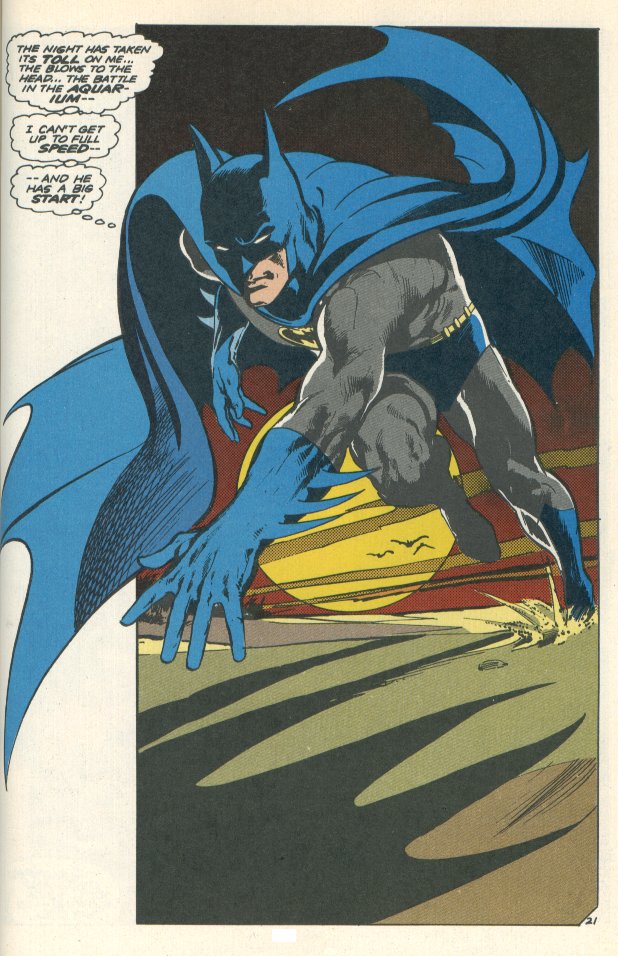
And this bigger, more sensational, more comicky Batman demands a more comicky plot. For this reason I like the Riddler’s brain-draining Box. We’re no longer dealing with crime bosses in clown makeup and angry mutants planning child kidnappings. This is supervillainy. The Riddler is only stealing money for production capital, as he says. What he really wants to steal are your thoughts, your intelligence, your secrets. This Riddler is recession-proof. Money can buy you power, but information is power; why steal one when you can steal the other?
Jim Carrey’s Riddler isn’t quite "my" Riddler, but he shows flashes of being a great supervillain in his own right nonetheless. I do think the “obsessed stalker” angle is a workable one. The main problem is he starts to get on your nerves. I don’t know that his performance is any more restrained than Frank Gorshin’s in the Batman TV show, but Gorshin seems to be working peaks and valleys. He’ll be manic energy one moment and then calm down the next; there is, I’ll argue when we get to Batman ’66, a surprising subtlety to his performance. But Carrey is almost always cranked up to 11. It becomes exhausting.
Still, there are some moments where he stops performing, where he stops doing schtick for an audience, and really gets into a certain megalomaniacal headspace. There’s a swell sequence where he returns to his apartment after killing his boss, walks up to his mechanical “Guesser” fortune-telling machine and says in a gently gleeful half-confession: “Guess what I did today?” And once in awhile, you really do get the feeling that he’s the Riddler and Val Kilmer is Batman, and you’re seeing a real comic; sometimes Carrey says “Batman” and he really means it.
Tommy Lee Jones, however, doesn’t have a whole lot to redeem him. Coincidentally, the Riddler and Two-Face are my favorite Batman villains, but they’re not really recognizable in this movie. Two-Face’s coin-flipping thing never ends up really meaning anything; when he and the Riddler invade Wayne Manor and his flip lands “good side” up, he just flips it again until he gets the result he wants. I could say that it puts the lie to Harvey Dent’s supposed reliance on the coin, that it’s all just psychobabble excuses to hide the fact that he’s actually a horrible, horrible person, but I’m not sure I want to let anybody off the hook for this. Jones is cranked up to 11 all the time as well. There's no duality at all coming from this Two-Face; he’s scarred side up all the time without a trace of the other side. If anyone could benefit from peaks and valleys, it’s him.
But back to the good things about this movie, it also does some interesting things with that “real world”/”comic book world” interface, and it does this primarily through Chris O’Donnell’s Robin and Nicole Kidman’s Dr. Chase Meridian.
Despite references to Metropolis (and thus Superman, indirectly) in this movie, it seems to be that Batman is a new idea; he’s not the latest link in a chain going back to some “Golden Age.” He was one of the first superheroes in this world, if not the first, if not the only. Bruce Wayne invented Batman as a way to deal with his trauma, as a way of solving the problem of crime in Gotham City. But Dick Grayson doesn’t have to invent Robin because there’s precedent now; he sees Batman and goes “Oh, this is an option for me” and goes about becoming a superhero. It’s an idea you can find in Watchmen and a few other places, actually, with Hooded Justice dressing up in a costume and Nite Owl and a few others being inspired by him – all it takes to turn an "ordinary" fictional world into a superhero world is one guy to put on a costume and get the ball rolling.
Dr. Meridian is also, I’d argue, more interesting than you might think. She comes on almost ridiculously strong in her first few scenes with Batman with the snappy banter and aggressively vampy smile, and it’s almost too much until you see her interact with Bruce Wayne, and suddenly she’s dialed it back by a magnitude of five (here’s someone working peaks and valleys). There’s still some nice repartee, but it’s not so showy and over-the-top; it’s playful and not vamping. And then it starts to make sense. Dr. Meridian is this movie’s version of Batman Returns’ Max Schreck – an ordinary person trying way too hard to seem like one of Gotham’s extraordinary figures. On the roof of police headquarters, she comes short of actually saying that she’s trying to be Catwoman. But where Schreck’s villainy is utterly trumped by Catwoman’s supervillainy (thanks again for that notion, plok), once Dr. Meridian actually kisses Batman, she decides it was a hollow goal and turns back. It turns out she’d rather be with Bruce Wayne (played in a low-key fashion by Kilmer; where Bale throws people off his trail by pretending to be an idiot playboy, Kilmer does so, whether this was his intent or not, by playing Bruce as a staggeringly dull individual). She picks the real guy over the fantasy, however boring the real guy might be; Chase Meridian outgrows Batman.
See, there is interesting stuff happening in this movie, it’s just buried under a lot of gunk, and I’m not sure exactly who to blame for it. Schumacher for being the director? The studio execs for demanding a more commercial movie than Batman Returns? The writers for not putting enough in the script? (There’s this little “dream warden” doll that’s half white, half black, and there’s Bruce talking about “two sides” to himself, and it seems like it should link to Two-Face somehow but it never does.) Jones and Carrey, for just being them? Hard to say. It’s a shame, though. But the good stuff always shines through for me.
Short version: A seriously flawed movie with only the most awesome of intentions.
Next: Three to go!
Wednesday, June 10, 2009
Seven Films for Seven Batmen, No. 5: BATMAN RETURNS (1992)
Okay, trying really hard to weed out pure nostalgia, because this movie is always a treat for me in that it returns me to age 8.
I'm not gonna be too long on this one because there's already a good-sized critique of Batman Returns to be found here, and I find it hard to argue with most of the criticisms, although I find them much less infuriating.
But. Everything in this movie is obvious; there is no mystery. A lot of things seem more interesting than they really are. The Batman/Bruce/Catwoman/Selina thing is a love quadrangle that turns out to be between just two people, but then it’s like, is it just two people? It seems interesting because it keeps reversing itself, but there’s never any question where it’s going to go, so it’s really just a formal interest. Likewise Christopher Walken’s Max Schreck. There’s a certain potential for commentary from Tim Burton here, that the so-called “respectable people” are just as monstrous, if not moreso, than the “freaks,” but it’s not a lesson learned because it’s obvious from the start that this is a bad guy, and all of the characters in the movie (Bruce, Selina, Alfred, the mayor, the Penguin) are already aware of this as well, so it kind of loses its effect. The only people who seem to be fooled by Max are the nameless Gotham crowds; is the Penguin right to call them “pinhead puppets” after all?
I do however, ultimately love Schreck for the reasons you’ll find in that essay I linked to above; he’s an ordinary businessman who thinks he’s a supervillain, and he dresses fancifully and says all these stock villainous phrases, but Walken’s performance is so awkward, deliberate or not, that it exposes him as a poseur. Like that Charlie Caligula character from Grant Morrison’s "Batman RIP"story, who only pretended to be a crazy criminal so everyone would think he was an evil mastermind like the Joker. There’s that intersection of the “real world” and the comics world again.
Danny DeVito's Penguin, however, has no redeeming qualities. I never find him all that compelling, and his vulgar jokes are only annoying. There’s a certain anti-surprise at work here as well. He seems interesting because he seems to be set up as a tragic character, a monster trying to get in touch with his humanity. Sometimes it’s a show, like his over-the-top phony forgiveness of his parents, but when he insists one of his henchmen call him “Oswald” instead of “Penguin,” well, that’s got to be genuine, right? Is his monologue to Schreck at the beginning of the movie fake or real? If it is real, why does he seem to have the plan to kill the first-born sons of Gotham in place from the very beginning? If it’s real, why doesn’t the Penguin find satisfaction when the people of Gotham readily accept him? But if it’s fake, why does the music indicate sincerity?
The impression I am left with is that the Penguin is an irredeemably evil freak, which seems like an uncharacteristic message in a Tim Burton movie. Contrast it with perhaps the most obvious example, Edward Scissorhands, about an individual who is hated and perceived to be evil because of his appearance but is actually good; the Penguin is quickly accepted by the people of Gotham despite his appearance and turns out to be evil all along. Were the Cobblepots right to toss the kid in the drink all along?
Despite the movie as a whole not really hanging together, I find this to be such a likable sensory experience. It’s beautifully shot and wonderful just to look at. The music is some of Danny Elfman’s best (helped in my estimation, in no small part I am sure, by the fact that I had a cassette tape of the score when I was a boy). Michael Keaton’s Batsuit in this movie is as good as the black leather look gets in any Batman film to date. I love the rocket penguins — an almost perfect expression of the mix of absurdity and danger you find in Gotham City. And I think it is a brilliant choice to play Elman's exciting Batman march over the image of the Penguin’s bassinet lazily drifting through the sewer instead of an action sequence; the theme becomes more of an overture, standing apart from the movie rather than being a part of it (although I am almost positive that I am using musical terms totally incorrectly).
But the thing that ultimately elevates this movie is that Burton has chosen to put Batman in a fairytale, and it turns out to be absolutely wonderful. Everything, from that nearly wordless opening “once upon a time” sequence, to the Christmastime setting, is in service to that. How would emperor penguins really “raise” a child, anyway? But you accept it (I accept it, at least) because this is a demented little storybook narrative that Batman has somehow managed to intersect with, and the result is a stylized environment in which a larger-than-life character like Batman can thrive.
Short version: I find this compelling because of Burton’s style, although as a result it’s maybe a better Tim Burton movie than it is a Batman movie.
Next: A landmark (well, a man can dream, can he not?) defense of a film generally hated by fans.
Monday, June 8, 2009
Seven Films for Seven Batmen, No. 6: BATMAN BEGINS (2005)
(Being a countdown of the seven live-action major motion pictures featuring Batman. Mission statement here, the list so far here.)
So, Batman Begins at No. 6. This may possibly be an unpopular choice, but I am totally willing to debate this. I hard a hard time deciding which movie to name the “second-worst,” because frankly, aside from Batman & Robin, I do actually like all the other Batman movies for one reason or another, although I admit there’s pretty substantial flaws in most of them. Ultimately I have to give the sixth-place nod to Begins, but I do just want to make it clear that even though this only a step up from Batman & Robin on the list, there is a considerable gulf in quality between the two.
Let’s talk about what’s good. I do have to say I was terribly impressed with how this movie works in relation to the previous ones. The studio wanted to reboot the franchise, but they also wanted villains we hadn’t already seen in a movie to smooth the transition. Scarecrow and Ra’s al Ghul probably aren’t many filmmakers’ first choice for Batman villains, but because of that they never threaten to take over the movie (a criticism many have about Tim Burton’s and Joel Schumacher’s entries), allowing us to focus on Bruce Wayne, which is sort of the mission statement of this movie. That said, Christopher Nolan & Co. manage to make the villains integral to the movie -- not just plotwise, but also thematically. To center Batman’s origin around fear, and then to be able to tie that into the Scarecrow’s fear toxin, and to be able to tie that back to Ra’s … well, I do appreciate the sense of unity.
Also, Christian Bale is perhaps the most believable Bruce Wayne and Batman, for what that’s worth. Driven, almost obsessively so, but he never veers into that “psycho-Bat” territory. I appreciate that it feels like he’s got a mission, not a war. Also, I always enjoy the Scarlet Pimpernel-type foppish persona, so there’s that.
Alfred serves a different function than he does in other interpretations. Usually he serves (pun?) to keep Bruce grounded, to pull him away from the edge when he starts to get too into the Batman persona. He’s a facilitator, where Michael Caine’s Alfred is an instigator. Because Bale is less sure of himself than the Bruce Wayne we’re used to, Caine has to take a much more active role in shaping Batman. This isn’t necessarily my ideal Alfred, but it works in the context of this movie; Bale’s Bruce needs an Alfred and a Lucius and a Rachel to guide this Batman-in-training. (Is it significant that a proactive Alfred is portrayed as somewhat lower class than the traditional, reactive, stiff-upper-lip Alfred? Or is it just Michael Caine being Michael Caine?)
Entertaining acting to be had all around (well, except for poor Katie Holmes, maybe). So why does Begins rank so (comparatively) low? I have to say, the first time I saw it I thought it was amazing and probably the best Batman movie to date, but time and distance have cooled me on it somewhat. To start us off, I’ll pull out something I wrote in an e-mail recently:
“I think part of the reason comics aren't subversive anymore is because they don’t *have* to be. You don’t have to hint at this weird antagonistic romance between Batman and Catwoman anymore because the kids are gone, and now they can just sleep together and talk about it; the subtext is free to be just text, but now the stories don’t mean anything greater than what they are.”
This is my biggest complaint with this movie: All the just-under-the-surface stuff we associate with Batman is brought to sea level. Characters talk at length about Batman as a symbol, what he represents, whether Bruce or Batman is “the mask.” At times it feels like Batman 101—as though the screenwriters took an essay they’d written about Batman and dramatized it. A cry for legitimacy, perhaps? Assuring people after Batman & Robin that, look, Batman isn’t just some square-jawed superhero, he can have psychological depth, too, promise! But the movie's not an exploration of themes, it’s a discussion, with breaks for action sequences.
Worse, all this sort of on-the-nose stuff really strips away the grandeur. Christian Bale’s Bruce Wayne as a child watches opera, but the Bruce Wayne of the comics lives opera. Christopher Nolan tries to explain Batman in this movie, trying for a measure of psychological realism and giving you reasons why, for example, Batman needs a cape. But do you really need to know that Batman has long pointy ears on his mask so that he can fit a radio in there? This Batman-by-trial-and-error eliminates any trace of mystery; it’s less mythic than, say the Batman of the comics or Burton’s Batman, who just is, who just appears and says “This is the way it has to be.”
So Nolan’s look at how a “real” Batman would come to be is interesting on the face of it, but the problem is that it ultimately can’t account for everything it needs to. Because nobody could really do what Batman does. That vanishing trick he always pulls when Commissioner Gordon turns his back on him? You can’t do that, unless you’re actually hiding behind the curtains or under a desk. Unlike a lot of people, I liked the claustrophobic fighting style, that horror movie way of not showing everything. But it doesn’t quite fit in with what a “real” Batman would probably do, which is walk up to you in his heavily armored costume and punch and kick you really hard. Saying he learned these nifty tricks from the League of Shadows isn’t all that satisfying. It’s handwaiving, isn’t it? “Ninjas can do crazy stuff” is a perfectly acceptable explanation in a comic book movie, but it’s at odds with the “Somebody could really be Batman if they worked hard enough and had the resources” angle Nolan is taking.
Ultimately, I think the Scarecrow is the most interesting character in the movie, because he alone seems to make that mysterious, magical leap from “real world” to “comic book character” without some overzealous explanation. He alone seems like a real Batman character -- a guy who starts out a bit odd, and then something pushes him over the edge into supervillainy. There’s something unusual, something unexplained in the restrained excitement in his performance when he says, “Would you like to see my mask?” It’s transformative; the burlap sack over the face is a great visual to sum up the Batman villain: Bad guy plus. I sometimes want to see more of him, but I’m wary that more screen time would spoil him.
There’s nitpicky things, too. I wish Gotham City didn’t just look like Chicago (I understand why it does, so I'll put this down to personal preference). I don’t care for the “I’m not going to kill you, but I don’t have to save you" rationalization. I think the suit is awkward-looking, especially compared with Michael Keaton’s sleek version in Batman Returns more than ten years earlier.
Also, I am absolutely frustrated by the lack of a strong musical theme. The theme for Burton’s movies and the theme for Schumacher’s movies are very different, but they’re both extremely rousing and paint a larger-than-life picture. I don’t think subtlety in film scoring does Batman any favors.
Short version: My real reservation with this movie is that it’s about a man who’s trying to turn himself into a legend instead of being about a man who is a legend, with all the self-consciousness that entails.
Next: A beautiful, intriguing movie ... but not really all that much of a Batman movie.
So, Batman Begins at No. 6. This may possibly be an unpopular choice, but I am totally willing to debate this. I hard a hard time deciding which movie to name the “second-worst,” because frankly, aside from Batman & Robin, I do actually like all the other Batman movies for one reason or another, although I admit there’s pretty substantial flaws in most of them. Ultimately I have to give the sixth-place nod to Begins, but I do just want to make it clear that even though this only a step up from Batman & Robin on the list, there is a considerable gulf in quality between the two.
Let’s talk about what’s good. I do have to say I was terribly impressed with how this movie works in relation to the previous ones. The studio wanted to reboot the franchise, but they also wanted villains we hadn’t already seen in a movie to smooth the transition. Scarecrow and Ra’s al Ghul probably aren’t many filmmakers’ first choice for Batman villains, but because of that they never threaten to take over the movie (a criticism many have about Tim Burton’s and Joel Schumacher’s entries), allowing us to focus on Bruce Wayne, which is sort of the mission statement of this movie. That said, Christopher Nolan & Co. manage to make the villains integral to the movie -- not just plotwise, but also thematically. To center Batman’s origin around fear, and then to be able to tie that into the Scarecrow’s fear toxin, and to be able to tie that back to Ra’s … well, I do appreciate the sense of unity.
Also, Christian Bale is perhaps the most believable Bruce Wayne and Batman, for what that’s worth. Driven, almost obsessively so, but he never veers into that “psycho-Bat” territory. I appreciate that it feels like he’s got a mission, not a war. Also, I always enjoy the Scarlet Pimpernel-type foppish persona, so there’s that.
Alfred serves a different function than he does in other interpretations. Usually he serves (pun?) to keep Bruce grounded, to pull him away from the edge when he starts to get too into the Batman persona. He’s a facilitator, where Michael Caine’s Alfred is an instigator. Because Bale is less sure of himself than the Bruce Wayne we’re used to, Caine has to take a much more active role in shaping Batman. This isn’t necessarily my ideal Alfred, but it works in the context of this movie; Bale’s Bruce needs an Alfred and a Lucius and a Rachel to guide this Batman-in-training. (Is it significant that a proactive Alfred is portrayed as somewhat lower class than the traditional, reactive, stiff-upper-lip Alfred? Or is it just Michael Caine being Michael Caine?)
Entertaining acting to be had all around (well, except for poor Katie Holmes, maybe). So why does Begins rank so (comparatively) low? I have to say, the first time I saw it I thought it was amazing and probably the best Batman movie to date, but time and distance have cooled me on it somewhat. To start us off, I’ll pull out something I wrote in an e-mail recently:
“I think part of the reason comics aren't subversive anymore is because they don’t *have* to be. You don’t have to hint at this weird antagonistic romance between Batman and Catwoman anymore because the kids are gone, and now they can just sleep together and talk about it; the subtext is free to be just text, but now the stories don’t mean anything greater than what they are.”
This is my biggest complaint with this movie: All the just-under-the-surface stuff we associate with Batman is brought to sea level. Characters talk at length about Batman as a symbol, what he represents, whether Bruce or Batman is “the mask.” At times it feels like Batman 101—as though the screenwriters took an essay they’d written about Batman and dramatized it. A cry for legitimacy, perhaps? Assuring people after Batman & Robin that, look, Batman isn’t just some square-jawed superhero, he can have psychological depth, too, promise! But the movie's not an exploration of themes, it’s a discussion, with breaks for action sequences.
Worse, all this sort of on-the-nose stuff really strips away the grandeur. Christian Bale’s Bruce Wayne as a child watches opera, but the Bruce Wayne of the comics lives opera. Christopher Nolan tries to explain Batman in this movie, trying for a measure of psychological realism and giving you reasons why, for example, Batman needs a cape. But do you really need to know that Batman has long pointy ears on his mask so that he can fit a radio in there? This Batman-by-trial-and-error eliminates any trace of mystery; it’s less mythic than, say the Batman of the comics or Burton’s Batman, who just is, who just appears and says “This is the way it has to be.”
So Nolan’s look at how a “real” Batman would come to be is interesting on the face of it, but the problem is that it ultimately can’t account for everything it needs to. Because nobody could really do what Batman does. That vanishing trick he always pulls when Commissioner Gordon turns his back on him? You can’t do that, unless you’re actually hiding behind the curtains or under a desk. Unlike a lot of people, I liked the claustrophobic fighting style, that horror movie way of not showing everything. But it doesn’t quite fit in with what a “real” Batman would probably do, which is walk up to you in his heavily armored costume and punch and kick you really hard. Saying he learned these nifty tricks from the League of Shadows isn’t all that satisfying. It’s handwaiving, isn’t it? “Ninjas can do crazy stuff” is a perfectly acceptable explanation in a comic book movie, but it’s at odds with the “Somebody could really be Batman if they worked hard enough and had the resources” angle Nolan is taking.
Ultimately, I think the Scarecrow is the most interesting character in the movie, because he alone seems to make that mysterious, magical leap from “real world” to “comic book character” without some overzealous explanation. He alone seems like a real Batman character -- a guy who starts out a bit odd, and then something pushes him over the edge into supervillainy. There’s something unusual, something unexplained in the restrained excitement in his performance when he says, “Would you like to see my mask?” It’s transformative; the burlap sack over the face is a great visual to sum up the Batman villain: Bad guy plus. I sometimes want to see more of him, but I’m wary that more screen time would spoil him.
There’s nitpicky things, too. I wish Gotham City didn’t just look like Chicago (I understand why it does, so I'll put this down to personal preference). I don’t care for the “I’m not going to kill you, but I don’t have to save you" rationalization. I think the suit is awkward-looking, especially compared with Michael Keaton’s sleek version in Batman Returns more than ten years earlier.
Also, I am absolutely frustrated by the lack of a strong musical theme. The theme for Burton’s movies and the theme for Schumacher’s movies are very different, but they’re both extremely rousing and paint a larger-than-life picture. I don’t think subtlety in film scoring does Batman any favors.
Short version: My real reservation with this movie is that it’s about a man who’s trying to turn himself into a legend instead of being about a man who is a legend, with all the self-consciousness that entails.
Next: A beautiful, intriguing movie ... but not really all that much of a Batman movie.
Friday, June 5, 2009
Seven Films for Seven Batmen, No. 7: BATMAN & ROBIN (1997)
(Being a countdown of the seven live-action major motion pictures featuring Batman. Mission statement here, the list so far here.)
I rewatched this a year or so ago because I wanted to re-evaluate it. I didn’t want to dismiss this movie; I didn’t want to just parrot conventional wisdom that this is two absolutely worthless hours of film. Most fan complaints (the ones trying a bit harder than “OMG batman n robin is soooo ghey,” at least) focus on this movie not being "dark" enough, but I am totally up for a fun Batman (as I’ll talk about when we get to Batman Forever). I thought, perhaps, that I might be able to find some hidden value to this movie that went overlooked amidst all the obvious complaints.
So I watched this movie and set aside all my preconceived notions, and I can assure that this is in fact two absolutely worthless hours of film.
Well, I shouldn’t say “worthless.” It is an absolute treat to watch John Glover playing an over-the-top mad scientist (though I may be biased). I was also intrigued, oddly, by the way Commissioner Gordon is still Pat Hingle, but rather than being dressed in a shirt, tie and overcoat the way he was in the first movies, he’s in some kind of snappy police uniform in this one. It’s an extremely comic book-like signifier -- you can tell he’s a cop because he’s dressed like the coppiest cop who ever copped. It suggests a kind of engagement with stylized comic-book reality at the expense of “realism,” much in the same way that the Wachowskis did Speed Racer. You could also make the case, if you wish to view the Burton-through-Schumacher movies as one continuous series, for “escalation”; Gotham City gets weirder and crazier the more that Batman is around, and by the time you get to Batman & Robin, his influence has morphed Gotham into this glitzy, insane place, and Gordon has to dress in that uniform to keep up, so to speak. In some ways, I'm tempted to say this movie is more ambitious than it is given credit for, or at least it could be. Batman Forever tried to fuse the black-clad Tim Burton Batman with the bright colors of Adam West’s world; Batman & Robin doesn’t just fuse them, it puts 'em in a blender and sets it to "puree."
So why doesn’t it work?
The acting, I’d argue, is a big part of it. It’s over-the-top, but it’s lacking the necessary deadpan. Adam West played the role with such deadly seriousness that people assumed for years that he hadn’t been in on the joke. If you watch Batman ’66, there’s a scene where Batman calls up a naval official who foolishly was duped into selling the Penguin a pre-atomic submarine, and the actor playing the official gives an performance that sticks out like a sore thumb because unlike Burt Ward or Alan Napier, he’s mugging for the camera; he's not significantly more exaggerated than anybody else, but he’s doing everything short of winking at the camera to say “Look how absurd we’re being,” and it kills the moment.
And everyone in Batman & Robin is like that. Uma Thurman plays Poisony Ivy like a Saturday Night Live sketch instead of delivering her lines with the straightfaced absurdity you need to pull this off. If everybody’s falling over themselves to prove they’re in on the joke, there is no joke (there isn’t even any real satire), and since there’s no actual drama either, there’s no point to watching it. By contrast, when West says “To the Batcave, Robin, we haven’t a moment to lose!” you almost believe he believes it, so it’s funny and a little exciting, despite yourself.
The other flaw in the movie is the dialogue. Same problem that The Spirit had too, actually. If you’re going to fill the movie full of stylized banter and repartee, it probably ought to be clever. You can have clever but unrealistic dialogue or stupid but realistic dialogue, but stupid and unrealistic is just wasting everyone’s time. I also would point out that having an actor whose English is somewhat labored deliver English-language-based puns is an unwise decision; Vincent Price’s Egghead could pull it off, Schwarzenegger’s Mr. Freeze less so.
Maybe George Clooney could have made an okay Batman, but we’ll never know, will we? No longer a tortured soul, this Bruce Wayne is growing into the role of Dad in a Bat-Family, a warm, sort of swaggering guy who nevertheless has to keep the kids in line once and awhile. Alfred’s brush with death is an interesting idea, and makes a theoretically interesting pairing with the emergence of the Bat-Family; if his symbolic “father” were to die, it would break the status quo of Bruce as the eternal son, and he could then grow into the fatherly role himself. But the “serious bits” are all handled so perfunctorily; get 'em done and off the screen.
Short version: I bet there is an interesting movie you could make working with the barest bones of what Batman & Robin gives you, but you're never really allowed to connect with characters, the themes, or the “real world/comic world” interface.
Also: how did they manage to cast Uma Thurman as Poison Ivy and end up with a totally unappealing result? It’s like they made an effort. Even now I have trouble believing that this was not the most alluring thing that has ever been filmed.
Next: A Batman movie that was, perhaps, more necessary than it was actually enjoyable.
Thursday, June 4, 2009
Seven Films for Seven Batmen: Introduction
The weekly Superhero Theory feature on this ol' blog is going on hiatus for a bit in favor of a new series of posts to come over the next two weeks or so.
I have resolved -- for no other reason than I have a blog, and you are reading it -- to rank the popular, wide-release live-action Batman movies (which I will define here as Batman ’66, Batman ’89, Batman Returns, Batman Forever, Batman & Robin, Batman Begins, and The Dark Knight, leaving out the less popular '40s serials, fan films, and weird little unauthorized things like Andy Warhol’s Batman Dracula). I didn’t want to rank the “best” Batman movies based purely on critical analysis (whatever that ultimately means for the Batman series), nor just my “favorite” Batman movies based on personal preference, but some kind of aggregate of the two. (Maybe 66% heart, 34% brain?) Ultimately, what I tried to do was rank them according to my personal reactions after filtering out pure boyhood nostalgia as much as possible.
Now, the tricky part. Some might argue that you can’t actually compare Batman ’66 with ’89 with Batman & Robin with The Dark Knight. They are, after all, trying to do very different things (unlike, say, the James Bond movies, in which the producers generally tried to maintain consistency of brand by nixing any changes, both story-wise and stylistically, that could be seen as too radical). But that is in fact perfect for Batman, who has always been open to various, contradicting interpretations.
However, since the intent varies so greatly from film to film, it is hard to compare each movie as a whole, as a film, with the others. Instead, I’ve tried to look at each movie’s components -- specifically, components that are unique to Batman movies, like how Gotham City is handled, how the villains are handled, specific themes, Bat-iconography, the intrusion of comic-book reality upon the “real world”, and, of course, the interpretation of Batman himself -- and weigh how successful they all are at what they’re trying to do, and what they maybe ought to be doing.
Short version: Seven movies, totally subjective, but I thought really hard about this, you guys.
Each post will cover one movie with a little analysis, and there'll be a new post up every few days whenever the next one gets written. At the end, maybe, a short wrap-up about what I've learned from all this? Shorter, bullet-point rankings of best Batman, best villains, best Batmobile and the like? Eh, we'll see when we get there.
We begin tomorrow with the somewhat predictable bottom.
I have resolved -- for no other reason than I have a blog, and you are reading it -- to rank the popular, wide-release live-action Batman movies (which I will define here as Batman ’66, Batman ’89, Batman Returns, Batman Forever, Batman & Robin, Batman Begins, and The Dark Knight, leaving out the less popular '40s serials, fan films, and weird little unauthorized things like Andy Warhol’s Batman Dracula). I didn’t want to rank the “best” Batman movies based purely on critical analysis (whatever that ultimately means for the Batman series), nor just my “favorite” Batman movies based on personal preference, but some kind of aggregate of the two. (Maybe 66% heart, 34% brain?) Ultimately, what I tried to do was rank them according to my personal reactions after filtering out pure boyhood nostalgia as much as possible.
Now, the tricky part. Some might argue that you can’t actually compare Batman ’66 with ’89 with Batman & Robin with The Dark Knight. They are, after all, trying to do very different things (unlike, say, the James Bond movies, in which the producers generally tried to maintain consistency of brand by nixing any changes, both story-wise and stylistically, that could be seen as too radical). But that is in fact perfect for Batman, who has always been open to various, contradicting interpretations.
However, since the intent varies so greatly from film to film, it is hard to compare each movie as a whole, as a film, with the others. Instead, I’ve tried to look at each movie’s components -- specifically, components that are unique to Batman movies, like how Gotham City is handled, how the villains are handled, specific themes, Bat-iconography, the intrusion of comic-book reality upon the “real world”, and, of course, the interpretation of Batman himself -- and weigh how successful they all are at what they’re trying to do, and what they maybe ought to be doing.
Short version: Seven movies, totally subjective, but I thought really hard about this, you guys.
Each post will cover one movie with a little analysis, and there'll be a new post up every few days whenever the next one gets written. At the end, maybe, a short wrap-up about what I've learned from all this? Shorter, bullet-point rankings of best Batman, best villains, best Batmobile and the like? Eh, we'll see when we get there.
We begin tomorrow with the somewhat predictable bottom.
Wednesday, March 25, 2009
The Hall of Actors I Will Watch In Pretty Much Anything
I am sure I am not the only person with a list like this.
But first, I should clarify what it means to be included. This isn't just a list of good actors (although I would say everyone on this list is a good actor). It’s a list of actors I find particularly compelling, and yes, that is an intentionally vague descriptor.
There is a certain uncritical-ness at work here, something hard to explain. I could sum it up by saying I just plain like these actors. I like “hanging out” with them while I am watching the movie or show; they project an innate charm or something. (I suppose that’s almost a condemnation, because an actor is supposed to make you forget he or she is acting and accept the role completely. Hm.)
There should also be something personal about your own list -- the actors on it should seem unusual choices to most, prompting a reaction on the order of “Yeah, I think I’ve seen him in a couple of things, I guess, but I wouldn't say I'm a fan...” I’m not including obvious choices because they’re just that -- obvious. I like Jack Black because he’s usually funny in whatever he’s in, but he’s not on this list. I like Johnny Depp because he always gives an idiosyncratic performance, but he’s not on the list. Sean Connery and Bruce Campbell are geek icons, and Gregory Peck is just straight-up a really talented actor, but none of them are on this list.
So who is on this list?
Here are the inaugural inductees into the Hall of Actors I Will Watch In Pretty Much Anything:
Malcolm McDowell: This guy is the perfect example of what I’m talking about. McDowell has been in some really good movies, but he has also been in a lot of terrible movies and TV shows. And yet, I always want to watch him. Maybe it’s that I want to listen to him; he’s got such an icy, sinister voice. He gets typecast as a villain because of it -- in Tank Girl, Blue Thunder, Star Trek: Generations, and he was Metallo in the Superman cartoon, remember. I watched this really crummy made-for-TV Disney movie called Princess of Thieves about Robin Hood’s daughter (played by Keira Knightley when she was like sixteen or something) where he’s the Sheriff of Nottingham, and he’s awesome. Every time I hear they’re making a new James Bond, I always hope they’ll cast him as the bad guy. A lot of actors would feel bad about that, but from what I’ve read he just enjoys working. So he’ll do some really neat British indie, and then he’ll do a slasher movie, just because they asked. I respect that.
John Glover: You never go to the video store and go, “Oh, I need to get a movie with John Glover in it.” But you’re flipping through the TV Guide and you see he’s in something and you’re like, “I should watch that.” I first saw him in Gremlins 2, which was one of my favorite movies as a kid, so maybe that imprinted on me. I love the smarmy, intellectual Riddler he played on Batman: The Animated Series, his mad scientist in Batman & Robin was the only thing I really enjoyed about that movie, and there was a time in college where I was only watching Smallville because John Glover is awesome as Lionel Luthor, and because Allison Mack is pretty. Also, he was really good in Love! Valour! Compassion!, which is pretty much a 180 from those comic book projects.
Ian McShane: He is a new addition, and it's funny because I’ve never seen Deadwood. Josh pointed him out to me, and all of a sudden I see (and hear) him in all sorts of stuff. I’m really not digging NBC’s Kings, but even if his character’s not very compelling, he is.
Ian McKellen: He just seems like a cool guy. People call him the greatest living Shakespearian actor, and yet he’ll do X-Men and give it some dignity and look like he’s having a fun time. Also, he hosted Saturday Night Live once and it was amazing. You know how Ben Affleck will be in, like, maybe six sketches when he does the show? McKellen was almost in every single one, including "Weekend Update," where he dressed up as Maggie Smith and kissed Jimmy Fallon. It was rad.
Kenneth Branagh: I like that he does these “Shakespeare for the masses” movies, but whenever I find he’s in something that doesn’t involve the Bard, I’m compelled to see it. I wish Wild Wild West had been a better movie, and I remember being really disappointed when I heard he’d dropped out of the villain role in Mission: Impossible III.
Emma Thompson: Y’know, I’ve never seen Dead Again, which has Branagh and Thompson and my mom even owns a copy of it on VHS. Where is my head at?
Gene Hackman: What an awesome dude. I forget he’s in a lot of things because he’s so versatile. Superman and The Royal Tenenbaums are two of my favorite movies, and he’s in both of ‘em. He was in Heartbreakers and Welcome to Mooseport, but don't hold it against him because he was enjoyable in both. His Lex Luthor bears almost no resemblance to one of my favorite comics characters, but I wouldn’t have it any other way.
Jane Lynch: I actually haven’t seen her in all that much, but she always takes me by surprise by appearing in things I was not expecting. You can just be watching some random X-Files or Frasier one day, and she’ll be doing a guest role in that episode. It is always a pleasant surprise.
Alan Cumming: He is just an adorable fellow. I would almost watch Son of the Mask. Almost.
So who’s in your Hall of Actors I Will Watch In Pretty Much Anything?
But first, I should clarify what it means to be included. This isn't just a list of good actors (although I would say everyone on this list is a good actor). It’s a list of actors I find particularly compelling, and yes, that is an intentionally vague descriptor.
There is a certain uncritical-ness at work here, something hard to explain. I could sum it up by saying I just plain like these actors. I like “hanging out” with them while I am watching the movie or show; they project an innate charm or something. (I suppose that’s almost a condemnation, because an actor is supposed to make you forget he or she is acting and accept the role completely. Hm.)
There should also be something personal about your own list -- the actors on it should seem unusual choices to most, prompting a reaction on the order of “Yeah, I think I’ve seen him in a couple of things, I guess, but I wouldn't say I'm a fan...” I’m not including obvious choices because they’re just that -- obvious. I like Jack Black because he’s usually funny in whatever he’s in, but he’s not on this list. I like Johnny Depp because he always gives an idiosyncratic performance, but he’s not on the list. Sean Connery and Bruce Campbell are geek icons, and Gregory Peck is just straight-up a really talented actor, but none of them are on this list.
So who is on this list?
Here are the inaugural inductees into the Hall of Actors I Will Watch In Pretty Much Anything:
Malcolm McDowell: This guy is the perfect example of what I’m talking about. McDowell has been in some really good movies, but he has also been in a lot of terrible movies and TV shows. And yet, I always want to watch him. Maybe it’s that I want to listen to him; he’s got such an icy, sinister voice. He gets typecast as a villain because of it -- in Tank Girl, Blue Thunder, Star Trek: Generations, and he was Metallo in the Superman cartoon, remember. I watched this really crummy made-for-TV Disney movie called Princess of Thieves about Robin Hood’s daughter (played by Keira Knightley when she was like sixteen or something) where he’s the Sheriff of Nottingham, and he’s awesome. Every time I hear they’re making a new James Bond, I always hope they’ll cast him as the bad guy. A lot of actors would feel bad about that, but from what I’ve read he just enjoys working. So he’ll do some really neat British indie, and then he’ll do a slasher movie, just because they asked. I respect that.
John Glover: You never go to the video store and go, “Oh, I need to get a movie with John Glover in it.” But you’re flipping through the TV Guide and you see he’s in something and you’re like, “I should watch that.” I first saw him in Gremlins 2, which was one of my favorite movies as a kid, so maybe that imprinted on me. I love the smarmy, intellectual Riddler he played on Batman: The Animated Series, his mad scientist in Batman & Robin was the only thing I really enjoyed about that movie, and there was a time in college where I was only watching Smallville because John Glover is awesome as Lionel Luthor, and because Allison Mack is pretty. Also, he was really good in Love! Valour! Compassion!, which is pretty much a 180 from those comic book projects.
Ian McShane: He is a new addition, and it's funny because I’ve never seen Deadwood. Josh pointed him out to me, and all of a sudden I see (and hear) him in all sorts of stuff. I’m really not digging NBC’s Kings, but even if his character’s not very compelling, he is.
Ian McKellen: He just seems like a cool guy. People call him the greatest living Shakespearian actor, and yet he’ll do X-Men and give it some dignity and look like he’s having a fun time. Also, he hosted Saturday Night Live once and it was amazing. You know how Ben Affleck will be in, like, maybe six sketches when he does the show? McKellen was almost in every single one, including "Weekend Update," where he dressed up as Maggie Smith and kissed Jimmy Fallon. It was rad.
Kenneth Branagh: I like that he does these “Shakespeare for the masses” movies, but whenever I find he’s in something that doesn’t involve the Bard, I’m compelled to see it. I wish Wild Wild West had been a better movie, and I remember being really disappointed when I heard he’d dropped out of the villain role in Mission: Impossible III.
Emma Thompson: Y’know, I’ve never seen Dead Again, which has Branagh and Thompson and my mom even owns a copy of it on VHS. Where is my head at?
Gene Hackman: What an awesome dude. I forget he’s in a lot of things because he’s so versatile. Superman and The Royal Tenenbaums are two of my favorite movies, and he’s in both of ‘em. He was in Heartbreakers and Welcome to Mooseport, but don't hold it against him because he was enjoyable in both. His Lex Luthor bears almost no resemblance to one of my favorite comics characters, but I wouldn’t have it any other way.
Jane Lynch: I actually haven’t seen her in all that much, but she always takes me by surprise by appearing in things I was not expecting. You can just be watching some random X-Files or Frasier one day, and she’ll be doing a guest role in that episode. It is always a pleasant surprise.
Alan Cumming: He is just an adorable fellow. I would almost watch Son of the Mask. Almost.
So who’s in your Hall of Actors I Will Watch In Pretty Much Anything?
Subscribe to:
Posts (Atom)